
A Deep Dive into India’s Tobacco Empire
While most of the stocks were falling day after day, one company was literally smoking the competition (and I mean that quite literally).
Godfrey Phillips India, the cigarette manufacturer you probably haven’t thought much about, just delivered quarterly results so spectacular that its stock price hit the upper circuit limit for two consecutive days. We’re talking about a 56% jump in net profit Y-o-Y, 27% Q-o-Q and the sweetener of a 2:1 bonus issue.
But here’s where it gets interesting: this isn’t just about one company’s stellar performance. It’s a window into one of India’s most controversial yet economically significant industries – tobacco. An industry that employs ~45 million people, generates over ₹53,000 crore annually in tax revenue, yet kills 3,500 Indians every single day.
The Godfrey Phillips Phenomenon
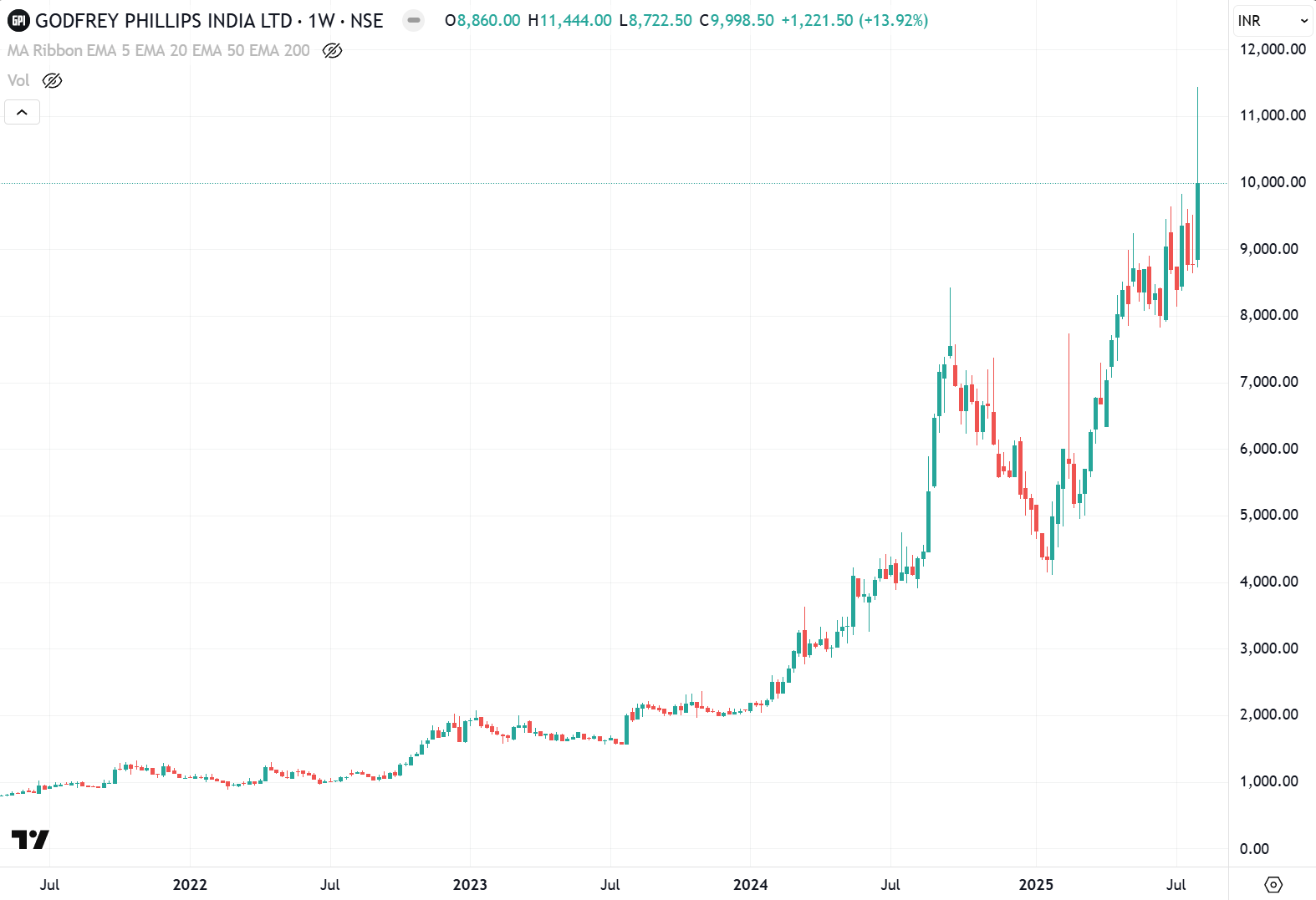
Let’s start with the numbers that made investors sit up and take notice. For Q1FY26, Godfrey Phillips posted a consolidated net profit of ₹356 crore, up a whopping 56% from the same quarter last year and 27% sequentially. Revenue surged 33% Y-o-Y to ₹1,813 crore, however fell 5.5% sequentally. But the real kicker? The operations margins went from a one-off dismal 17% last quarter to back to 23% which is also towards the upper end of the range it has maintaned for years.
The market’s reaction was swift and decisive. On August 5th and 6th, the stock hit the upper circuit limit of 10%, reaching an all-time high of ₹10,861.50. Even after some profit-taking today, the stock has delivered multibagger returns – almost 1000% in five years.
Founded as part of the Modi Enterprises, Godfrey Phillips commands iconic brands like Four Square, Red & White, and Cavanders. It also manufactures Marlboro under a licensing agreement with Philip Morris. With a presence in over 1 million retail outlets and 9,000+ sales personnel, it’s a formidable player in India’s tobacco landscape.

The Big Three: A Tale of Market Dominance
India’s cigarette market is essentially an oligopoly controlled by three giants. ITC Limited dominates with a market share exceeding 73%, making it not just India’s largest tobacco company but also one of the world’s biggest. Its flagship brands like Gold Flake, Wills, and Scissors are household names.
Godfrey Phillips holds the second position, while VST Industries, headquartered in Hyderabad, rounds out the top three. VST, which started as Vazir Sultan Tobacco Company in 1916, operates brands like Charminar, Total, and Charms. Interestingly, British American Tobacco maintains significant stakes in both ITC (23%) and VST (32%).
Together, these three companies account for 98% of India’s cigarette market.
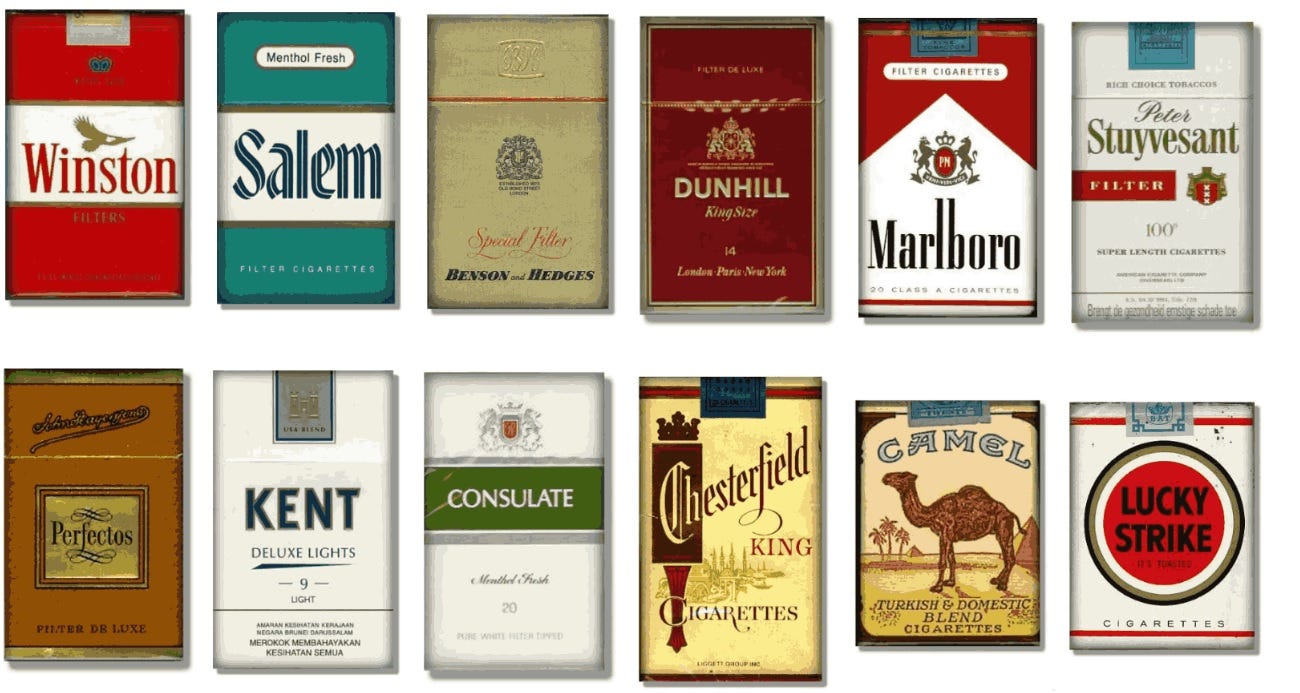
Most expensive cigarettes (2024)
The Uncomfortable Truth: Why India Can’t Just Ban Tobacco
Here’s the ten-lakh-rupee question: if tobacco kills over a million Indians annually and causes diseases ranging from cancer to heart ailments, why doesn’t the government simply ban it?
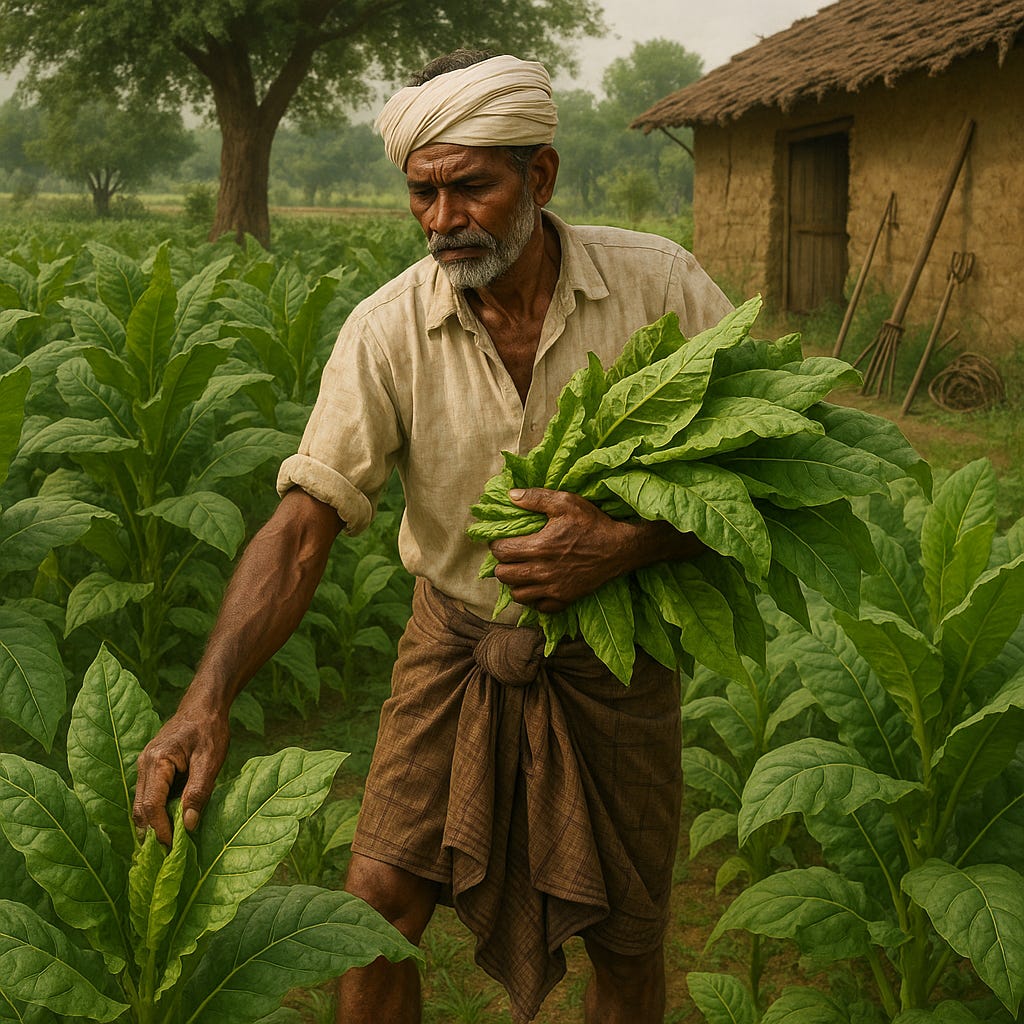
The answer is more complex than you might think. First, there’s the employment angle. The tobacco sector employs 45+ million people across farming, processing, manufacturing, and retail. That’s roughly the population of South Korea. For 6 million farmers and 20 million farm laborers, tobacco cultivation isn’t just a job, it’s their lifeline.
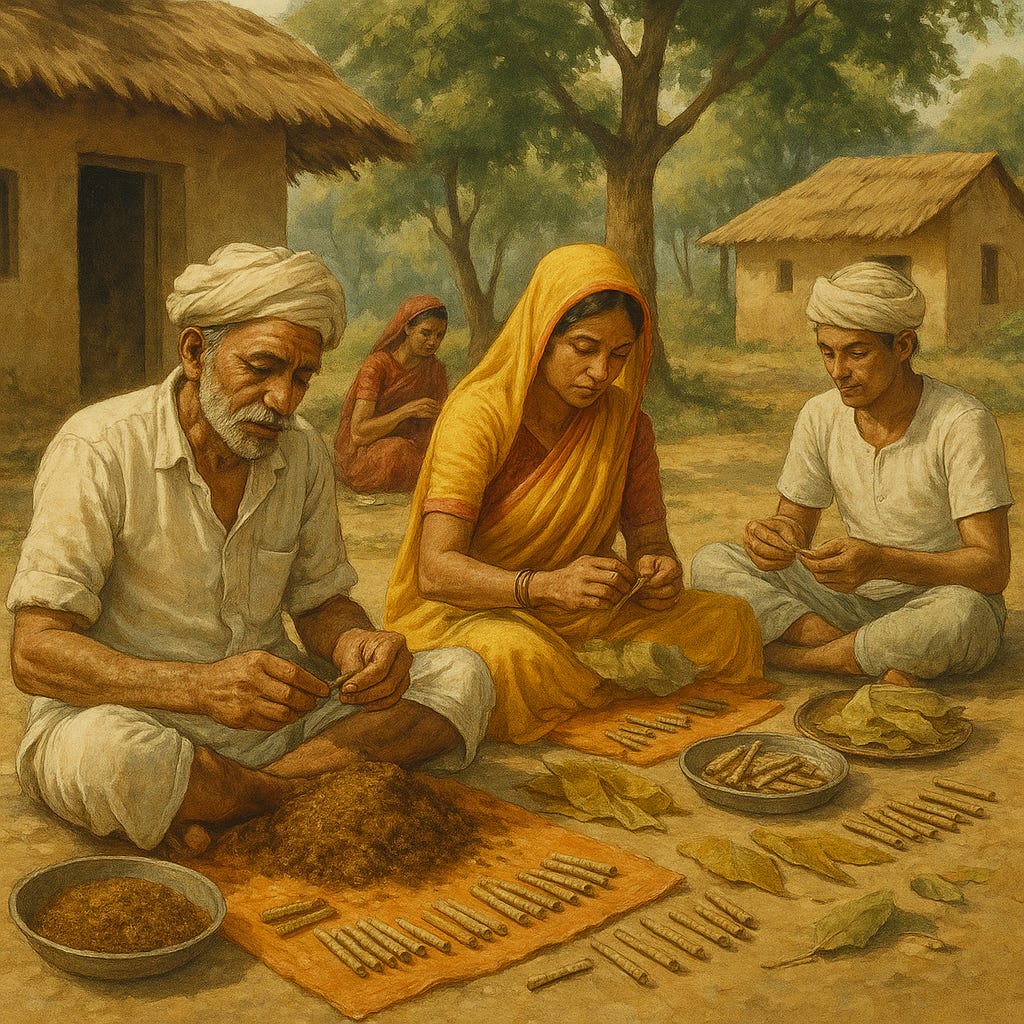
Tobacco is particularly crucial in drought-prone areas where other crops struggle. It’s a short-duration crop that can be harvested in three months, and there’s always a guaranteed buyer. For small farmers with less fertile land, tobacco often represents the difference between subsistence and survival.
Then there’s the economic reality. The government collects approximately ₹75,000 crore annually from tobacco taxes. That’s serious money, representing about 2.2% of India’s gross tax revenue. For every ₹100 the government collects in tobacco taxes, it spends only ₹0.07 on tobacco control programs. Talk about misplaced priorities.
The Bidi Paradox: India’s Unique Tobacco Problem
Here’s where India’s tobacco story gets particularly interesting. While cigarettes grab headlines, they represent only 14% of the tobacco market. The real action is in bidis.. hand-rolled cigarettes that account for 48% of market share. Smokeless tobacco products like gutkha make up another 38%.
The math is striking: there are 72 million bidi smokers versus just 38 million cigarette smokers. A cigarette costs ₹5.92 on average, while a bidi costs one-tenth of that. For millions of rural Indians, bidis aren’t just cheaper. They’re a way to suppress hunger during long working hours.
The bidi industry operates largely in the unorganized sector, employing small-scale producers who take advantage of tax exemptions for small manufacturers. It’s estimated that removing these exemptions could generate ₹14.8 billion in additional tax revenue while reducing bidi consumption by 6%.
The Tax Goldmine
India’s tobacco taxation structure reveals fascinating insights. The government imposes a 28% GST rate on tobacco products, along with compensation cess, excise duty, and National Calamity Contingent Duty. The total indirect tax burden reaches 53% – still below the World Health Organization’s recommended 75%.
Despite cigarettes representing only 10% of tobacco consumption, they contribute 80% of the government’s total tobacco revenue. This is because cigarettes face much higher taxation compared to bidis and smokeless tobacco, creating a perverse incentive structure.
The numbers are staggering: for every ₹100 the government earns from tobacco taxes, society bears ₹816 in economic costs due to tobacco-related diseases and deaths. The total economic burden of tobacco use amounts to 1.04% of India’s GDP – ~₹1,773 billion annually.
The Health vs. Economy Dilemma
The health implications are undeniable. Tobacco causes 1 million deaths annually in India. That’s roughly 8.9% of all deaths. It’s responsible for 18% of heart disease deaths, 40.7% of COPD deaths, and 60.4% of lung cancer deaths.
The economic burden on healthcare is equally alarming. Direct medical costs from tobacco-related diseases account for 5.3% of India’s total healthcare spending. With 250 million tobacco users in the country, this represents a massive drain on both public and private healthcare systems.
Yet, paradoxically, studies suggest that reducing tobacco consumption through higher taxes could actually boost the economy. A 10% reduction in tobacco use could lead to a net gain of 1.36 million jobs and increase GDP by 0.22% over five years, after accounting for prevented premature deaths.

Looking Ahead: The Path Forward
The tobacco industry in India represents one of the most complex policy challenges facing the country. It’s an industry that simultaneously provides livelihoods to millions while imposing enormous health and economic costs on society.
Recent policy discussions hint at potential changes. The government is considering raising GST on tobacco products to 40% after the compensation cess expires in 2026. There’s also talk of eliminating tax exemptions for small bidi producers, which could significantly impact the unorganized sector.
For companies like Godfrey Phillips, ITC, and VST Industries, the challenge will be navigating an increasingly complex regulatory landscape while maintaining profitability. Their recent financial performance suggests they’re managing this balance well, but the long-term trajectory remains uncertain.
The Godfrey Phillips story that captivated investors is ultimately a microcosm of India’s broader tobacco conundrum. It’s a tale of remarkable business success built on a product that society increasingly recognizes as harmful. As India marches toward becoming a developed economy by 2047, the tobacco sector’s role will likely undergo significant transformation.
Whether that transformation leads to a healthier society or simply reshuffles the deck remains to be seen. What’s certain is that with ₹75,000 crore in annual tax revenue and 45+ million livelihoods at stake, any changes will need to be carefully calibrated to balance economic realities with public health imperatives.
For now, investors are celebrating Godfrey Phillips’ stellar quarter while policymakers grapple with one of India’s most enduring economic paradoxes. In the world of tobacco, it seems, there are no simple answers – only smoke and mirrors.
Disclaimer: I am not a registered SEBI Research Analyst and the above article should not be construed as a recommendation. This should be solely for education purposes.
Disclosure: No direct holdings in any of the shares mentioned above.
References:
How India’s tobacco taxes fund addiction and ignore prevention [PDF]
An overview of the tobacco problem in India – PMC – PubMed Central
Tobacco – India – World Health Organization (WHO)
Tobacco use among Indian states: Key findings from the latest demographic health survey
Employment size of tobacco industry in India 2021, by type – Statista
India Legal Summary – Tobacco Control Laws
National Tobacco Control Programme – Ministry of Health and Family Welfare
Official websites of ITC, Godfrey Phillips and VST