
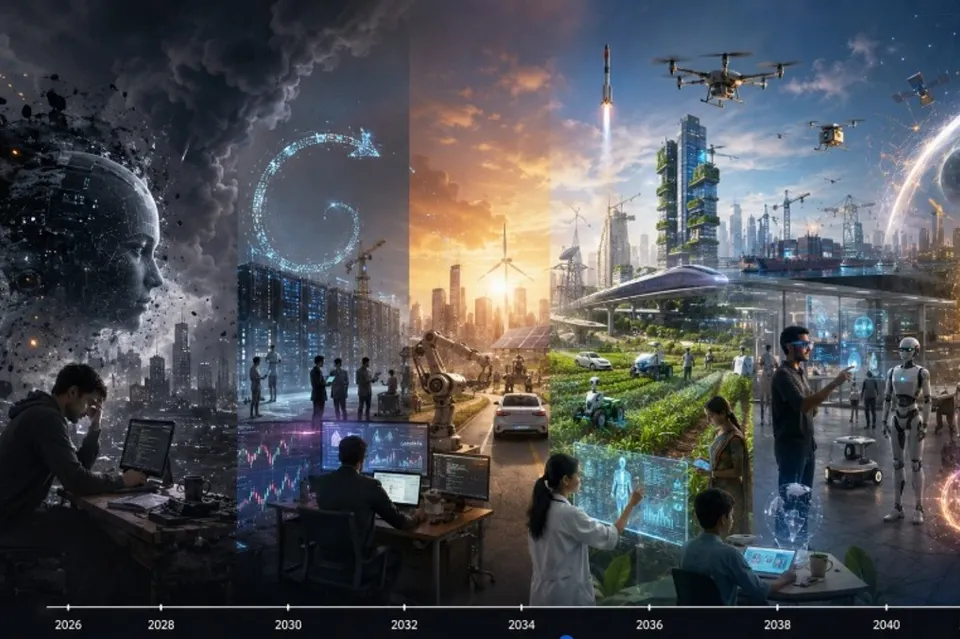
Mapping the Next 15+ Years of AI
This piece has taken us too much time and thoughts to create. We try to foresee how the world will shape in the next 15-20 years. There can be disagreements, which we will love to hear in comments. So, tighten your belt and read on.
The biggest mistake people make about AI is not that they underestimate it.
It is that they imagine it too neatly.
They picture a clean line: models get better, jobs disappear, society adapts, productivity rises, and then everything settles into a new normal. That is a comforting story because it makes the future feel legible. But it is probably wrong.
The more realistic shape is messier and more interesting.
It is closer to a wave, or a staircase, or a set of pressure systems moving across the economy.
A sharp climb.
A frustrating plateau.
Another climb.
Another stall.
Then a bigger jump.
Then a reordering of the rules again.
The intervals may be measured in years rather than decades, which is exactly why the whole transition may feel so unnerving.
That is the real reason AI feels both overhyped and underappreciated at the same time.
It is overhyped when people speak as if the world changes overnight.
It is underappreciated when people assume the current messiness means the wave is weak.
The historical pattern suggests otherwise. New general-purpose technologies usually go through a J-curve. At first, the old system breaks before the new one works properly.
Productivity falls, teams get confused, workflows are reconfigured, management loses its bearings, and the easy gains are mostly eaten by the cost of transition. Only later, once institutions reorganize around the new technology, do the gains show up in a visible way.
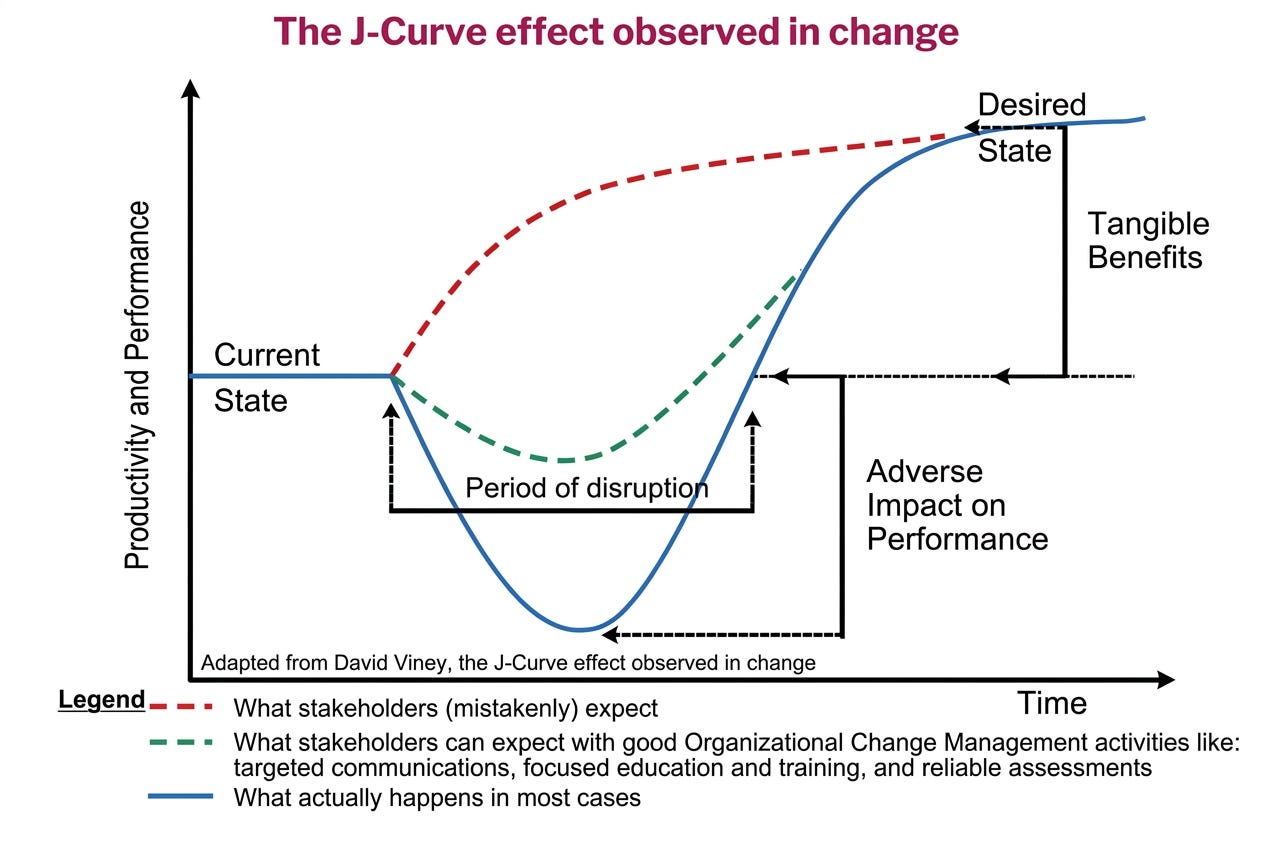
That is why electricity looked underwhelming for years before it transformed factories. That is why the internet looked speculative before it transformed commerce. And that is why AI may look noisy now, but far larger later.
The twist is that AI is not just another tool. It is a technology that improves the production of intelligence itself. That makes this transition different from electrification, different from software, different from mobile, and different from the internet. Those systems changed what humans could do. AI may change how much cognition the economy can buy, how quickly organizations can think, and how cheaply expertise can be simulated.
That is not just an economic shift.
It is a civilizational one.
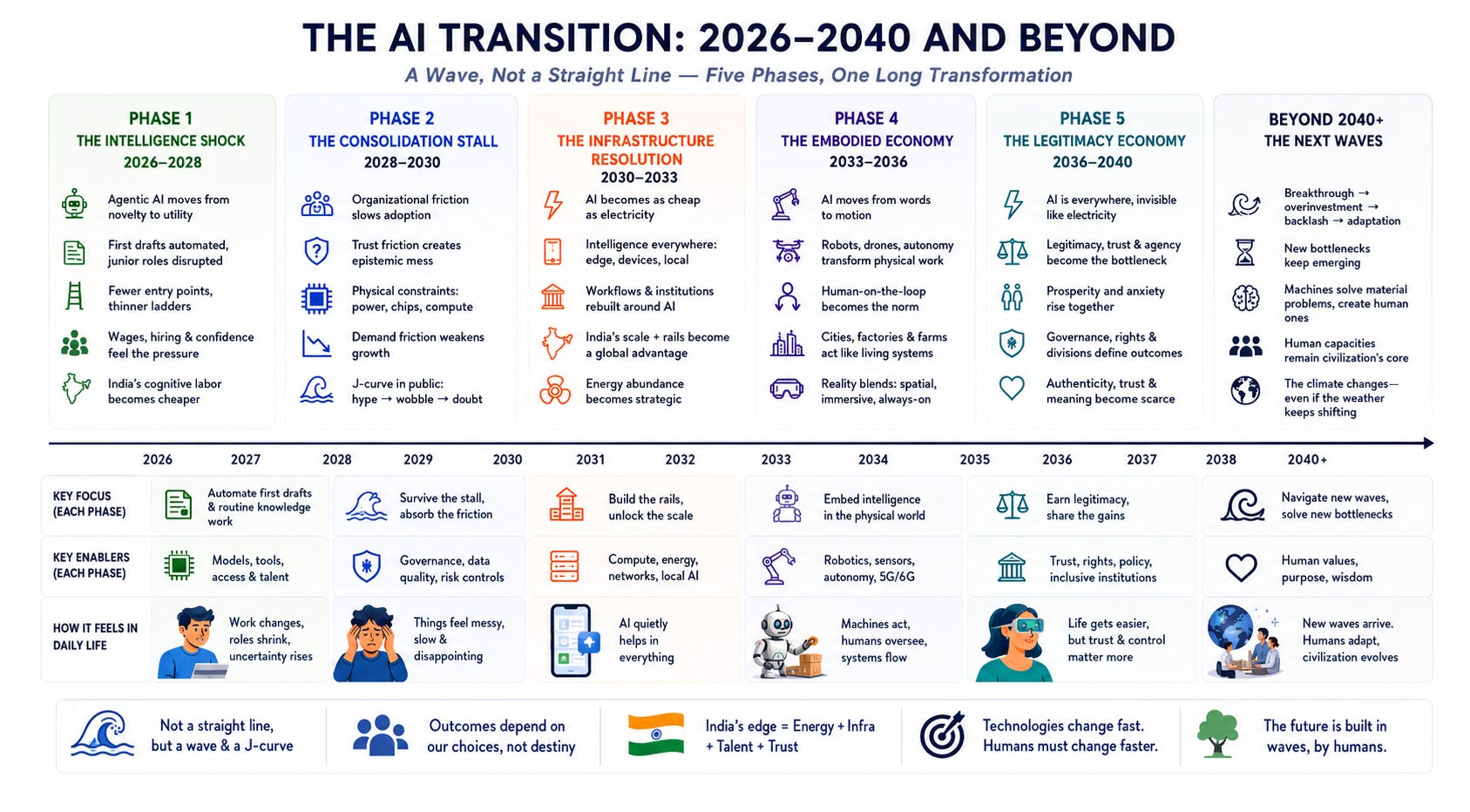
Phase One: The Intelligence Shock, now to 2028
This is the phase most people can already feel, even if they cannot fully name it.
Agentic AI moves from novelty to utility. It stops being a chatbot you ask questions to and becomes a system that can work through problems, use tools, check its own output, and chain together multi-step tasks. It writes code, revises documents, synthesizes research, drafts design variations, answers customer requests, processes data, and does the first pass of work that used to require a human junior worker.
The important detail is not that AI replaces the “best” work. It replaces the first draft.
And the first draft is where most white-collar work actually lives.
Most knowledge work is not genius. It is repetition wrapped in judgment. It is rewriting, researching, coordinating, troubleshooting, formatting, cleaning, and making one person’s context legible to another. AI is very good at the repetitive part, which means the economics of knowledge work begin to tilt.
This is where the pressure starts to show up in the real world.
- A company realizes the product spec can be drafted faster.
- A support team realizes routine tickets are already being handled by machines.
- A founder realizes a prototype can be built in a day rather than a month.
- A manager realizes a team of three can produce what once needed ten.
- A recruiter realizes the junior roles are not as necessary as before.
The result is not immediate mass unemployment. It is a subtler but more dangerous shift: fewer entry points, thinner ladders, more expectations, and more pressure on the people who remain.
That is why India matters so much in this phase.
India is not uniquely weak. It is uniquely exposed. A large part of its urban middle class is built on scalable cognitive labor: software, support, analytics, services, process work, documentation, coordination, maintenance, and operations. AI does not begin by replacing India’s dream. It begins by pricing it differently.
The first wave therefore creates a strange split.
On one side, companies and investors are euphoric.
Margins improve. Capital floods into compute, chips, data centers, and model-building. AI starts to look like the next great capital cycle.
On the other side, households begin to feel the strain. Not because everything collapses, but because the economics of being “smart” become less exclusive. That changes hiring, wages, status, and confidence. The consumer economy starts to feel the pinch before the full productivity gains show up.
That is the first great paradox of the AI era: the technology can be economically extraordinary while still being socially destabilizing.
Phase Two: The Consolidation Stall, roughly 2028 to 2030
Every serious technological wave hits a stall.
This is the phase that looks disappointing to people who expected magic. It is also the phase that often decides whether the technology becomes a civilization-changing force or remains a powerful but contained one.
What causes the stall?
- First, organizational friction. Companies can buy AI tools quickly, but they cannot rewire how they think overnight. New technology is never just software; it is a demand for new workflows, new habits, new accountability structures, and new management styles. Humans coordinate slowly. That remains one of the biggest invisible costs in the economy.
- Second, trust friction. The more AI gets embedded into daily work, the more people notice the epistemic mess it can create: hallucinations, synthetic confidence, bad citations, fake content, blurred authorship, and the growing difficulty of knowing what is actually true. Once a technology becomes ordinary, people stop calling it AI and start assuming it is just part of life. That makes its biases and failures easier to ignore.
- Third, physical friction. AI is not weightless. It requires chips, power, cooling, land, storage, networks, and capital. The AI economy looks software-like on the surface, but underneath it is increasingly industrial. Energy becomes a constraint. Grid capacity becomes a constraint. Semiconductors become a constraint. Data-center lead times become a constraint.
- Fourth, demand friction. If enough workers lose income or see their bargaining power shrink, they spend less. That hurts consumer demand. That hurts firms. That hurts revenue. Then the pressure to automate rises again.
So the system enters a difficult middle phase. The models keep improving, but the old economy has not yet found its new shape. The public starts asking whether AI was overhyped. Markets wobble. Some AI companies fail. Others are acquired. The narratives become noisier.
That should not be read as the end of the wave.
It should be read as the J-curve showing up in public.
Phase Three: The Infrastructure Resolution, roughly 2030 to 2033
This is the phase where AI stops feeling magical and starts feeling unavoidable.
The first few years were loud: demos, copilots, viral tools, companies racing to say they had an AI strategy. But now something quieter and more powerful begins happening.
AI starts disappearing into the background. Your phone negotiates appointments before you wake up. Your car schedules its own maintenance because it already predicted the part failure two weeks earlier. A small factory in Coimbatore runs with half the downtime because its machines can now “sense” stress before a breakdown happens. A village clinic in Bihar uses an AI diagnostic layer that quietly catches diseases a tired human system would have missed.
This is the moment the technology stops acting like software and starts behaving like infrastructure.
The biggest shift is that intelligence itself becomes cheaper. Models shrink. Inference costs collapse. What once required giant cloud systems can now run locally on phones, laptops, glasses, hospital devices, factory sensors, even farm equipment. AI slowly becomes less like hiring a consultant and more like turning on electricity.
And just like electricity, the countries that benefit most are not necessarily the ones that invented it. They are the ones that reorganize society around it fastest.
This is where the real productivity surge begins. Not because AI writes better emails, but because workflows themselves are rebuilt around machine intelligence. Hospitals redesign patient flow. Ports redesign logistics. Schools redesign learning. Governments redesign paperwork. Entire layers of friction that people simply accepted for decades start looking absurd in hindsight.
For India, this phase could become unexpectedly important.
The country has always had one hidden advantage: scale under constraint. India learned how to build digital public infrastructure cheaply because it had to. Aadhaar, UPI, low-cost telecom, digital identity rails – all of these suddenly become launchpads for AI-native systems. Instead of importing expensive Western institutional models, India could build leaner ones from scratch: multilingual AI tutors, agricultural copilots for small farmers, AI-powered local courts, personalized public-health systems, rural manufacturing intelligence networks.
And energy quietly becomes destiny again.
The AI age turns out to be incredibly hungry for power. Data centers consume electricity at industrial scale. Nations that solve abundant energy first gain an enormous strategic edge. That is where India’s old thorium dream may unexpectedly re-enter the story. For decades, Homi Bhabha’s three-stage nuclear vision sounded too slow, too ambitious, too futuristic. But sometime in the early 2030s, as the world scrambles for stable baseload power, India’s long investment in thorium reactors and fast breeder systems could stop looking eccentric and start looking visionary.
The countries that thrive in this phase may not be the ones with the smartest chatbots.
They may simply be the ones that built enough energy, compute, and institutional trust before everyone else realized those were the real bottlenecks.
Phase Four: The Embodied Economy, roughly 2033 to 2036
Once intelligence becomes cheap enough, it starts escaping the screen.
This is where AI moves from words into motion.
At first the changes feel small. Warehouses with fewer workers. Delivery systems with more autonomy. Construction sites where robots handle the dangerous or repetitive tasks. Elder-care facilities where AI assistants quietly monitor health, medication, and movement. But then the compounding begins.
Cities start behaving differently.
Traffic lights adapt in real time. Buildings become partially self-managing. Drones inspect bridges before cracks become disasters. Ports coordinate themselves like giant machine organisms. Farms use AI-guided irrigation systems that understand soil better than humans ever could. In richer neighborhoods, humanoid assistants become common enough that children grow up treating them less like gadgets and more like appliances.
The weirdest part is not the technology itself.
It is how quickly people normalize it.
By this stage, the labor market also starts changing shape in a more visible way. A human is still present, but often no longer doing the task directly. The machine acts; the human supervises. A logistics manager oversees fleets of autonomous systems. A doctor spends less time diagnosing and more time interpreting edge cases. A lawyer becomes more strategist than drafter. A teacher becomes part mentor, part curator, part emotional anchor.
Human-in-the-loop slowly becomes human-on-the-loop.
Some people thrive in this world because they know how to direct systems. Others struggle because repeatable execution was where their value came from. That creates a strange psychological shift in society. Intelligence alone no longer guarantees leverage. Judgment, adaptability, emotional trust, and systems thinking begin mattering more.
This is also where physical and digital reality start blending together.
Not the cartoon version of the metaverse people mocked in the 2020s. Something subtler and far more immersive. Lightweight glasses replace many screens. Real-time translation becomes invisible. Digital twins mirror factories, roads, cities, even human bodies. Remote work no longer feels like staring into rectangles; it starts feeling spatial. People attend weddings holographically. Architects walk clients through buildings before they exist. Teenagers grow up with persistent AI companions that remember their lives better than social media ever did.
For many people, this will feel thrilling.
For others, deeply disorienting.
Because this is the first phase where society realizes AI is no longer just changing work.
It is changing what reality feels like.
Phase Five: The Legitimacy Economy, roughly 2036 to 2040
By now AI is everywhere, which means people stop noticing it.
Nobody says “AI-powered” anymore for the same reason nobody says “electricity-powered.” The systems are simply woven into daily life. Your health monitor talks to your insurance system. Your education profile follows you across jobs. Your AI assistant knows your schedule, your preferences, your weaknesses, your finances, your stress patterns, maybe even your emotional triggers.
Convenience reaches almost absurd levels.
A teenager in Nairobi can access the equivalent of a world-class tutor. A retiree in Tokyo has an AI medical companion monitoring subtle signs of disease years before symptoms appear. A small business owner in Jaipur can run operations once requiring an entire back office team. Human capability expands dramatically.
But this is also where the deepest tension appears.
Because once intelligence becomes abundant, the real question is no longer technological.
It becomes political and emotional.
Who owns the systems?
Who controls the models?
Who decides what is true?
Who gets visibility and who disappears?
Who benefits from automation and who becomes economically invisible?
Can a society remain psychologically healthy when machines outperform humans in more and more domains?
That is the real bottleneck now:
legitimacy.
People can tolerate inequality if they believe mobility still exists.
They can tolerate technology if they believe they still have agency.
But once citizens begin feeling like passive tenants inside systems they cannot understand or influence, the social contract starts weakening.
This phase may produce extraordinary prosperity and extraordinary anxiety at the same time.
Some countries respond by building strong institutional trust: transparent AI governance, digital rights, AI dividends, portable benefits, public compute infrastructure. Others drift toward surveillance capitalism or techno-authoritarianism, where every behavior becomes measurable, rankable, and optimizable.
And ironically, as intelligence becomes cheap, the things humans value most may become the least scalable things of all:
authenticity, attention, trust, beauty, physical presence, meaning, belonging.
The economy grows richer.
People spend more time searching for what still feels real.
So how does it end?
Probably not with one giant singularity moment.
More likely, the future keeps arriving in waves.
A breakthrough.
Then overinvestment.
Then backlash.
Then adaptation.
Then another breakthrough.
The cycle repeats because every solution creates a new bottleneck. First compute was scarce. Then energy became scarce. Then trust. Then attention. Then meaning itself.
And that may be the strangest part of the AI era:
the technology keeps solving material problems while creating more human ones.
At some point, human intelligence may no longer be the economy’s rarest resource. Machines will think faster, remember more, and coordinate huge systems better than people can. But societies will still depend on deeply human capacities: trust, legitimacy, cooperation, emotional stability, moral judgment, shared purpose.
The future economy may therefore stop rewarding raw cognition the way the industrial economy rewarded muscle or the software economy rewarded logic.
Instead, it may reward the ability to remain human inside systems that increasingly are not.
And perhaps that is why the AI transition feels so unsettling even now. Deep down, people sense this is not merely another technology cycle. It is civilization renegotiating its relationship with intelligence itself.
Real technological revolutions never feel clean while you are living through them.
They feel confusing.
Uneven.
Exciting.
Threatening.
Half-built and overhyped at the same time.
They arrive like weather.
Then, one day, you realize the climate has changed.
________________
Needless to say, this is a work of fiction, but has been drafted after a lot of research and intelligent foreward insights. Authors have used creative liberties. Since this is a prediction, it may or may not happen as mentioned above. We invite you to put your opinions in the comment box. We will love to read, understand your perspective, and respond.