

Remember that gym membership you signed up for in January? Or that premium subscription to a productivity app that seemed “essential” at the time?
I’ll bet you forgot about at least 3 of them this month.

The Silent Wealth Killer
Here’s what’s happening in your bank account right now: somewhere between ₹20,000 to ₹30,000 (or more) is disappearing every single month into subscriptions and recurring memberships, and most of you have no idea.
I’m not talking about your internet bill or phone plan. I’m talking about the invisible drain: streaming services, productivity apps, premium memberships, design tools, financial platforms, educational courses, cloud storage, and everything in between.
The scariest part? You probably have more than you need.
Most people I speak with can’t even list all their active subscriptions from memory. They’re scattered across different credit cards, digital wallets, and autopay settings. It’s like a financial blind spot that companies have carefully engineered to exploit.
How Companies Lock You In
Let’s talk about the business model here.
When you sign up for a subscription, the company doesn’t want it to be a conscious decision every month. So they do this:
1. The Long-Term Binding They offer yearly plans instead of monthly ones—usually at a “discount.” It sounds good, right? But here’s the trick: once you’ve paid ₹15,000 upfront, you’re emotionally committed to using it (sunk cost fallacy). You will.
2. The Autopay Silence The subscription automatically renews. Most of them send you an email notification… which you delete without reading. Or worse, you don’t even notice because it’s hidden in a “Promotions” folder.
3. The Friction Canceling is intentionally difficult. You have to dig through settings, wait on customer service, or (my favorite trick) call a phone number that’s busy for hours.
Meanwhile, you’re already charged for next month.
The Math That Breaks Your Wealth Building
Let me show you the real impact.
If you’re spending ₹20,000/month on subscriptions, that’s ₹2,40,000 per year.
I am not saying all of it is waste. Problem is most people are keeping 30-50% of these subscriptions they don’t even actively use.
Why We Keep Them (Psychology)
Before I give you solutions, let’s understand why we’re terrible at managing subscriptions:
“I’ll use it eventually” – That premium course you bought but never started? The app you downloaded to “organize your life”? Your brain loves potential. It hates admitting you made a bad decision.
“It’s just ₹500” – Small amounts feel invisible when they’re recurring. But ₹500/month × 12 months × multiple apps = ₹6,000+ yearly. That’s a vacation.
“I might need it” – FOMO (fear of missing out) is a powerful motivator. Especially with financial tools, productivity apps, and premium memberships. What if you drop the membership and suddenly need it?
“It’s for work/business” – This is the easiest rationalization. And sometimes it’s true. But be honest with yourself: are you actually using it to generate revenue?
To top it, there are so many AI tools now, which will bind you initially, make your life take a completely different turn, make you dependant on them and finally you will be forced to pay.
What are Claude, ChatGPT, etc doing? Ultimately when you are tired of waiting for your tokens to renew after 5 hours, you will eventually start the subscription.
The Solution: Audit, Track, Decide
Here’s what I do, and what you should do too.
Step 1: The Subscription Audit
Open your bank statements for the last 3 months. Write down every recurring charge. Credit card statements, UPI withdrawals, everything.
This is painful. You’ll find subscriptions you forgot existed.
Step 2: Create a Subscription Registry
I maintain a simple spreadsheet with these columns:
- Service Name — What is it?
- Monthly Cost — What do you pay?
- Annual Cost — ₹ monthly × 12
- Payment Method — Credit card/UPI/subscription platform
- Renewal Date — When does it renew?
- Business Use? — Is it essential for work/business?
- Last Used — When did you actually use it?
- Keep or Drop — Your decision
This takes 30 minutes to set up. It saves thousands.
Step 3: The Brutal Evaluation
For each subscription, ask yourself:
- Did I use this in the last 30 days? (Not “could I” but “did I”)
- Does it generate revenue or directly support my revenue? (Be honest)
- Can I achieve the same result with a free alternative?
- If I had to repay for this today, would I?
If you answer “No” to questions 1 and 2, it’s a candidate for cancellation.
Step 4: The Consolidation
Many subscriptions overlap. You don’t need Netflix and Prime and Jio Hotstar. You don’t need three note-taking apps.
Consolidate ruthlessly.
Step 5: Set a Review Schedule
Put this in your calendar: Last Saturday of every quarter.
Spend 30 minutes reviewing your subscriptions. What worked? What didn’t? Has anything become essential? Is anything becoming redundant?
My Personal Breakdown
I track every rupee. Right now, my subscription stack looks like this:
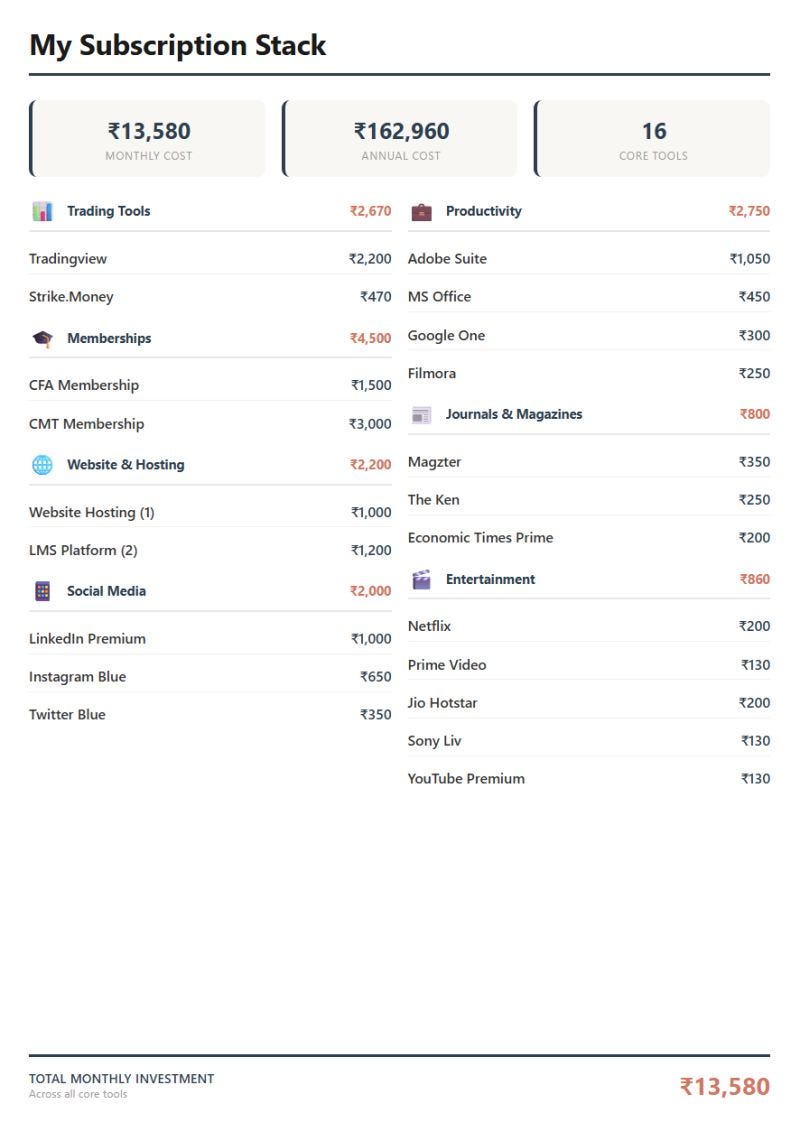
Every single item here is tracked. Every renewal date is marked. Every tool has been evaluated for ROI. And quarterly, I audit whether it still makes sense.
The professional tools are non-negotiable because they generate revenue. Entertainment is minimal but intentional for mental health (and usage for wife and parents). Productivity tools are duplicated strategically (Adobe + MS Office) because they serve different purposes.
Also, memberships of CFA Institute and CMT Association are a must, as it directly impacts my networking, credibility and hence business purposes.
Also, many of the above items are paid annually, but for calculation purposes, I have broken that amount down to monthly basis.
The above doesn’t include stuff like Wifi and Mobile phone bills because those are now as important as oxygen, but you should still time to time view your plan. If your usage is limited, may be you can change plan to a lower value.
The Uncomfortable Truth
If you’re spending ₹20,000/month on subscriptions and keeping only 50% of them, you’re throwing away ₹10,000/month into the void.
That’s ₹1,20,000/year of pure waste.
No investment strategy, no budgeting hack, no side hustle will compensate for that leakage.
The Action Plan
This week:
- Pull your last 3 months of bank statements
- List every recurring charge
- Calculate your total
Next week:
- Create your Subscription Registry
- Evaluate each one using the 4-question framework
- Cancel at least 3 subscriptions you don’t actively use
Going forward:
- Set a quarterly review reminder
- Before subscribing to anything new, remove something first
- Always choose monthly over yearly (unless you’ve used it for 3+ months)
Final Thought
Every great wealth builder I know obsesses over small expenses. Not because they’re misers, but because they understand that small leaks sink big ships.
Your subscription bleeding is one of those leaks.
Plug it.
What’s your subscription story? How much are you spending? Reply below—I’d love to hear what subscriptions you’re keeping and what you’ve killed.
And if you found this useful, please share it with someone who needs this wake-up call.