
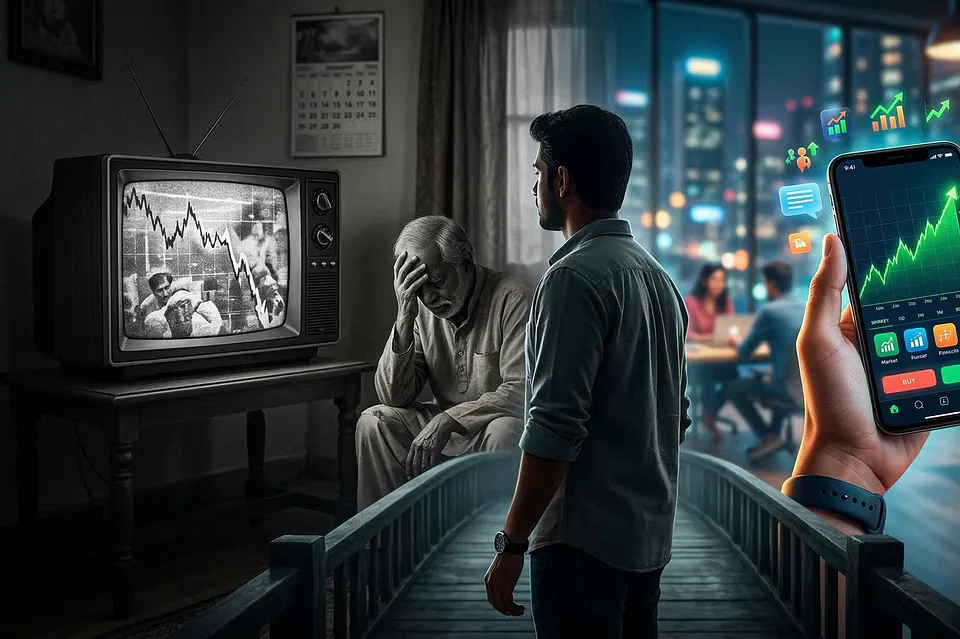
Gen Y / Millenials are stuck in between
For our parents’ generation, investing wasn’t a conversation; it was a lonely, high-stakes gamble in a vacuum.
Twenty or thirty years ago, the Indian retail investor lived in an information desert. When the screen turned red, it wasn’t a “market correction”, it was a personal catastrophe that happened in total isolation. They sat in front of a flickering television or waited for the morning paper to confirm their fears, feeling the walls close in.
There was no one in their ear telling them to “Buy the Dip.” There was only the visceral, animal instinct to run.
That generation didn’t have advisors; they had agents. And the difference between the two was usually a commission check that wasn’t aligned with the family’s survival.
They bought because a colleague made a killing in a mid-cap stock two weeks too late. They bought at the peak of the FOMO curve, fueled by anecdotes. And when the inevitable crash came? They fled. They called it “gambling” and swore off equities for decades, retreating to the cold, hard safety of Fixed Deposits or LIC Policies.
Fast forward to today. Sit in any cafe in Bangalore or a coworking space in Gurgaon, local trains of Mumbai or even common networking gathering of a tier 2 city, and the silence has been replaced by a deafening, 24/7 roar.
We have entered the era of the Ethical Moat.
The younger generation of investors entering the market today – the twenty-somethings who have never seen a physical share certificate, are equipped with something their parents couldn’t have imagined: abundant, free, and competitive information.
Today’s analysts, economists, and finfluencers aren’t hoarding secrets; they are competing for trust. In a world of infinite content, being unbiased is the only way to stay relevant. They don’t need your brokerage commission; they need your attention, rewarded by platform payouts and brand play. For the first time, the incentive structure has flipped: it actually pays to be the most genuine person in the room.
The result is a new kind of psychological armor.
When the market dips now, the group chats don’t fill with “How do I sell?” They fill with memes. There is a profound safety in seeing a viral joke about a portfolio being “in the ICU” while thousands of others double-tap in agreement.
The younger investor isn’t a victim; they are part of a cohort. They have companions in the drawdown.
Post-COVID, this new breed has been conditioned by the V-shaped recovery. They’ve watched the market bounce back so many times that the “Buy the Dip” mantra has moved from a theory to a religion. They are hungry to upskill, not just for “tips,” but for the why. I see it in my own classes; the willingness to learn is at an all-time high because they realize that in the modern market, literacy is the only real protection.
But every evolution has a predator.
If the “long-only” retail investor has learned to survive the volatility, who is still bleeding?
The blood on the floor today belongs to the leveraged. It’s the MTF users and the derivatives traders. They are playing a game where time is an enemy, not an ally. You can be 100% right about a company’s future, but if your broker triggers a margin call on a Tuesday morning because of a temporary 4% blip, your conviction is irrelevant. You are forced to sell. Your capital is finite, your time is rented, and the house eventually collects.
Our parents’ generation lost money because they didn’t know better. This new generation only loses money when they get too greedy to wait.
We have solved the information problem, but we are still wrestling with the greed problem. The ladder is there for anyone to climb, and it’s sturdier than it was thirty years ago. The only way to fall off now is to try and climb it with weights tied to your ankles – leverage, excess debt, and the delusion that you can outrun the clock.
If you can stay away from the siren song of 5x margins, you’re already winning. The “dizziness” of the red screen is just a feeling now, not a command to panic. We are sailing together. And as long as we don’t sink the boat with debt, the horizon looks remarkably bright.
Retail investors are doing better in 2020s.