It’s not just about Russia. It’s much deeper strategic move than that
1. Executive Summary: The “Hostile Maneuver.”
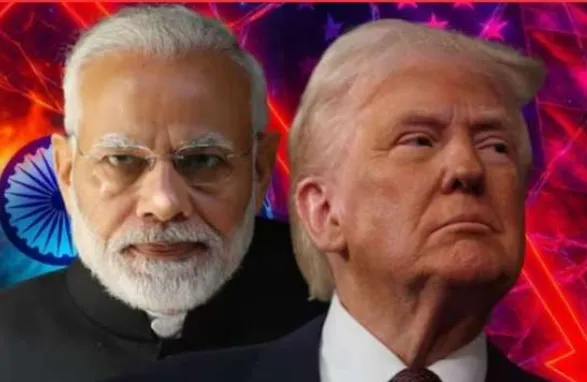
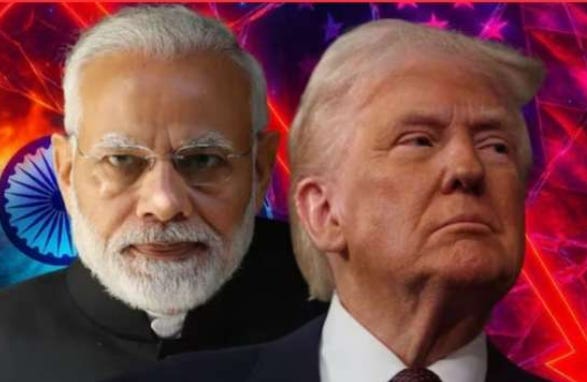
The looming threat of a 500% tariff on Indian exports is not merely a trade dispute; it is a geoeconomic “forced realignment” orchestrated by the Trump administration. The passage of the “Sanctioning Russia Act of 2025” is the legislative weapon designed to sever India’s energy lifeline to Russia.
The Core Thesis: The US military seizure of Venezuelan oil fields (Jan 3, 2026) has created a new, US-controlled supply of heavy crude. The US requires a guaranteed buyer to monetize this asset and restore global oil pricing power. India, with its refineries designed for heavy crude (like Venezuela’s Merey), is the target customer. The tariff threat is the lever to force India to swap Russian Urals (Enemy Supply) for US-controlled Venezuelan Crude (American Supply), thereby restoring US energy dominance and crushing the Rupee-Ruble trade mechanism.
Petrodollar Restoration: By forcing India to buy US-controlled Venezuelan oil, the transaction will revert to US Dollars. This reasserts US financial hegemony and destroys the alternative payment rail India and Russia were building.
2. The Legislative Weapon: “Sanctioning Russia Act 2025”
The legal mechanism for the 500% tariff is specific and targeted.
- Bill: S. 1241 (Sanctioning Russia Act of 2025).
- Sponsor: Senator Lindsey Graham (Greenlit by President Trump, Jan 7, 2026).
- Key Provision: Mandates a 500% tariff on all goods from countries that “knowingly engage in the exchange of Russian-origin uranium and petroleum products.”
- Targeting: While the bill mentions China and Brazil, analysts note that China is “too big to sanction” without domestic blowback. India is the “soft target” due to its trade surplus vulnerability.
- Trigger Mechanism: The President is granted waiver authority only if the target country demonstrates a “national interest” shift—i.e., switching energy suppliers.
Insight: Senator Graham explicitly stated the bill gives Trump “tremendous leverage” to force a choice between the US consumer market and Russian oil.
3. The Energy Pivot: Russia OUT, Venezuela IN
The data proves the US strategy is already effective. Indian refiners are capitulating before the law is even signed to avoid the 500% death blow. Even Reliance put the statement in the media on Jan 6, regarding the Reuters report that they have not received any Russian oil tanker in the past 3 weeks and none is expected in the month of January
A. The Collapse of Russian Imports
- Peak: ~2.0 Million bpd (June 2025).
- Current: Dropped to <1.2 Million bpd (Dec 2025).
B. The Venezuelan “Value Unlocking” (The Carrot)
With the US military seizing Maduro and controlling Venezuelan ports, the “Sanctions” barrier effectively vanishes for compliant allies.
- The Opportunity: India’s ONGC Videsh is owed approximately $1 Billion (including ~$500M in dividends) from the San Cristobal project.
- The Swap: The Trump administration is signaling a “Debt-for-Oil” swap. If India drops Russia, the US might allow ONGC and Reliance to lift Venezuelan crude to recover these debts.
- Technical Match: Reliance’s Jamnagar refinery is engineered for extra-heavy crude (Venezuela’s Merey). It is one of the largest refineries globally that can process this oil efficiently, making India the viable large-scale customer for US-controlled Venezuelan oil.
4. The Stalled FTA & The “Farm Crisis” Pressure
The US-India Free Trade Agreement (FTA) is deadlocked not just by tariffs, but by a desperate US need to offload agricultural surplus.
A. The GM Crop Ultimatum
- US Crisis: US farmers are sitting on a massive surplus of Soya and Corn after China slashed purchases.
- The Demand: The US is demanding India open its markets to Genetically Modified (GM) Soya and Corn.
- India’s Resistance: Indian govt resists because of losing popular support base in elections, environmental concerns and the “non-GM” premium its own agricultural exports command globally. The US views this as “protectionism.”
B. Digital Trade Walls
- The Conflict: The US wants a permanent WTO E-commerce Moratorium (no duties on digital transmissions).
- India’s Stance: India wants the right to tax digital imports (software, streaming) to protect domestic tech. The US sees this as a direct threat to its tech giants (Google, Meta, Microsoft).
5. Strategic Asymmetries: Why India Cannot Retaliate
Unlike China, India lacks the economic “kill switches” to fight a trade war with the US.
A. The “Surplus” Trap
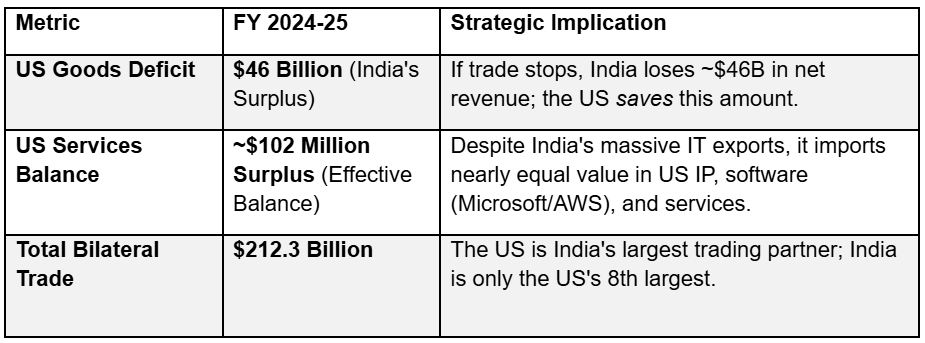
- US Goods Deficit: ~$45 Billion (India’s Surplus). If trade stops, India loses $46B in net revenue; the US saves this amount.
- Total Trade: The US is India’s largest trading partner. India is only the US’s 8th largest.
B. Rare Earth Elements (The Processing Gap)
India has the raw materials but not the ability to use them as a weapon.
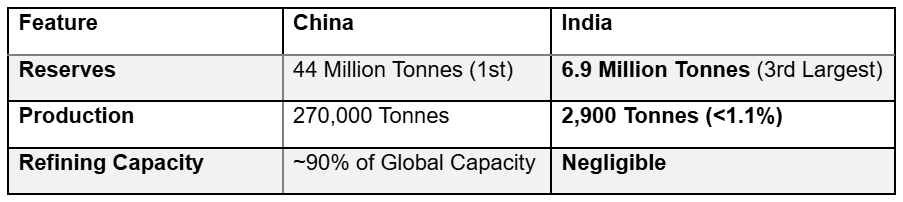
Insight: India cannot threaten the US with rare earths because it cannot refine its own ore. It relies on China for processing, neutralizing this as a geopolitical lever.
C. Pharmaceutical Vulnerability (The API Chokehold)
India is the “Pharmacy of the World” for finished generics, but it is effectively a “Packager” for Chinese ingredients.
- Dependency: India imports ~71.7% of its Active Pharmaceutical Ingredients (APIs) from China.
- Critical Drugs: For essential antibiotics (Cephalosporins, Azithromycin), dependence on China is 90-100%.
- Retaliation Risk: If India tries to cut drug supplies to the US, the US can source directly from China or boost domestic production. India would simply lose its highest-margin market.
6. Probability of Legislative Passage of 500% Tariff Bill
While the threat is real, the chances of this bill passing both chambers of Congress and being signed into law are high.
However:
A. The “Loss of Leverage” Paradox (Trump’s Preference)
- The Logic: President Trump historically prefers using Section 232 (National Security) or IEEPA (Emergency Powers) tariffs because they are Executive Actions. He can impose them on Monday and lift them on Tuesday if he gets a deal.
- The Problem with S. 1241: If Congress passes a law mandating 500% tariffs, the President loses the power to waive them easily. It ties his hands. Trump’s “Art of the Deal” style relies on flexibility; binding legislation destroys that flexibility.
- Precedent: In 2017, Congress passed CAATSA (Sanctions Act) with a veto-proof majority to force Trump to sanction Russia, limiting his ability to negotiate with Putin. He hated it. He is unlikely to support a similar bill that restricts his deal-making power with India.
B. The “Corporate Suicide” Factor (Lobbying)
A 500% tariff on India would be like a trade embargo. The lobbying backlash would be instant and lethal to the bill in the Senate.
- Retail Giants: Walmart and Target rely heavily on Indian textiles (sheets, towels, apparel).
- Pharma Lobby: The US healthcare system rely on Indian generics. 40-50% of generic drugs in the US come from India. There is no short-term substitute.
- Tech Sector: Apple and Google are expanding manufacturing in India (iPhone assembly) to escape China. This bill would hamper their “China Plus One” supply chain strategy. Apple imported $50 Billion worth of iphones from India in the last 5 years.
C. The “Sword of Damocles” Strategy
The bill is more valuable to the US administration pending than passed.
- As a Threat: It forces the Indian government to panic and open the economy for the US.
- As a Law: It causes a diplomatic rupture, pushes India permanently toward the BRICS currency block, and spikes US inflation.
- Conclusion: The bill is the “Bad Cop.” Once the “Good Cop” (Opening of Economy for US Goods) is accepted by India, the bill will likely die in the Committee stage or be “indefinitely tabled.”
7. Strategic Conclusion
The 500% tariff is a “Checkmate” move.
- Economic Suicide: India cannot afford a trade war that jeopardizes $45B in surplus and the entire IT sector.
- Energy Alignment: India’s refineries need heavy crude. The US now controls the only viable alternative to Russia (Venezuela).
- Outcome: India will likely capitulate on the “Russian Oil” issue, signing a long-term supply deal with US-controlled Venezuelan entities. This protects Indian exports and restores the “Strategic Partnership,” but at the cost of “Strategic Autonomy” which can be labeled as diversifying from different sources.
Contributed by my student – Abhijeet Kumar (IIM Indore, PGP 2026)
Disclaimer: I am not a registered SEBI Research Analyst and anything in the above article should not be construed as a recommendation. This should be read solely for education purposes.