
How SK Hynix made the AI bubble debate even more confusing.
The market just ran the entire “is AI a bubble” argument in one week, and the answer it gave was yes, no, and both
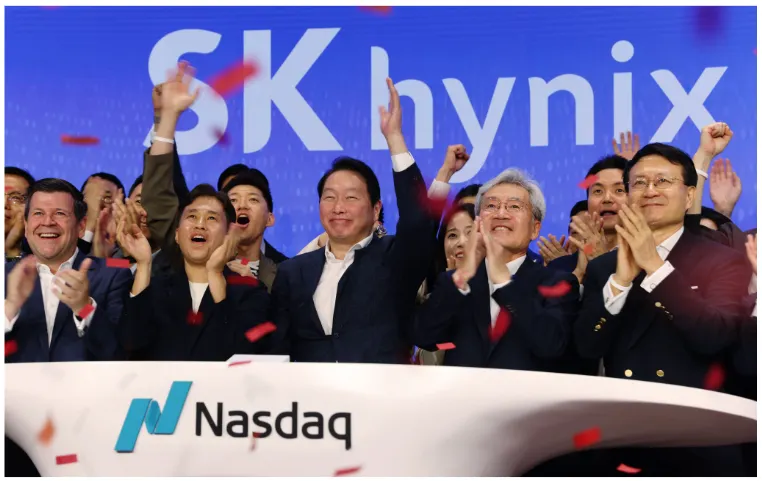
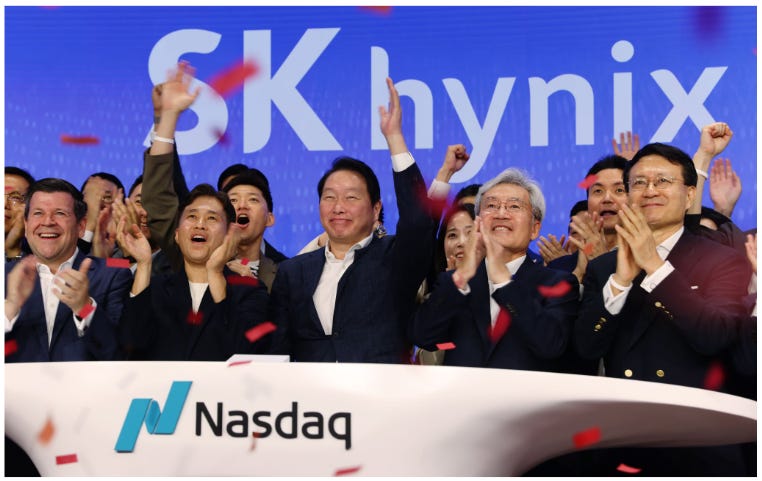
On July 10th, SK Hynix, a Korean memory-chip maker most Indian readers hadn’t heard of eighteen months ago, listed on the Nasdaq and raised $26.5 billion, the largest first-time share sale by a foreign company in US history. Shares opened 14% above offer, on operating margins above 70% and a sold-out 2026 production run.
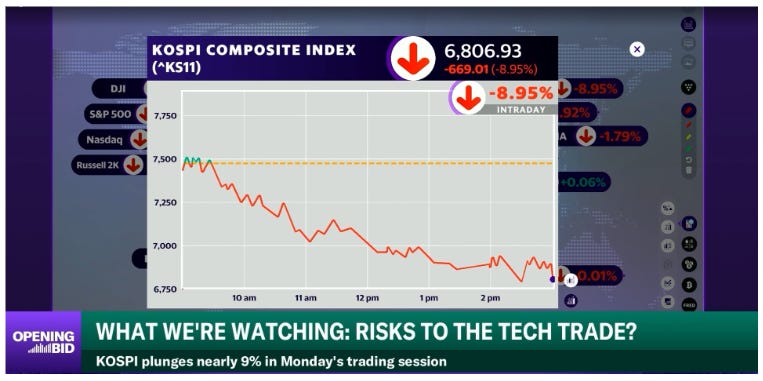
Three trading days later, its Korean shares fell 15.4%, the worst single day on record, dragging South Korea’s benchmark down 9% and triggering a trading halt. Samsung fell with it. Within 48 hours, the stock clawed back 27% after a bullish price target and a $531 billion Korean national AI plan. By July 15th, 36 of 37 analysts rated it a buy.
In one week, the same company had the biggest listing in Nasdaq history, its own worst crash, and a near-unanimous buy. The market didn’t resolve the bubble question. It voted for every answer at once.
That isn’t background noise for your next laptop. SK Hynix, Samsung, and Micron control the overwhelming majority of the world’s memory supply – the RAM in every phone, laptop, and console on Earth. Their stock is the leading indicator for what you’ll pay next.
The Morning Apple Blinked
Nine days before SK Hynix’s wild week, Apple raised prices mid-cycle for the first time in years, with no new hardware to justify it:
- MacBook Air: $1,099 → $1,299
- MacBook Pro: $1,699 → $1,999
Apple’s stock had its worst day in over a year.
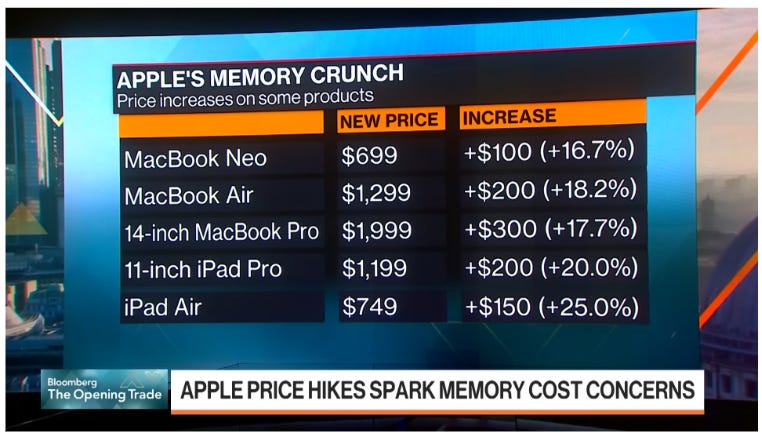
Tim Cook had warned it was coming: “This is a hundred-year flood. I’ve never seen anything like it in any area in over 40 years.” Apple admitted it had “never seen a component price increase this much, this quickly,” and had been shielding customers from the true cost for as long as it could.
The component was memory and prices moved because every chipmaker on Earth has been forced to choose between a laptop chip and a data-centre chip, when both increasingly come from the same factory.
Same Wafer, Different Buyer
Every memory chip starts as a slice of silicon called a wafer, carved into either:
- Ordinary DRAM: your laptop’s memory, or
- HBM: the stacked memory that sits beside an AI accelerator
A factory can’t do both with the same wafer, and the two aren’t equally efficient. HBM stacks dies eight to twelve layers high, where one speck of dust in one layer ruins the whole stack. The result: a gigabyte of HBM eats three to four times the wafer capacity of a gigabyte of ordinary memory.
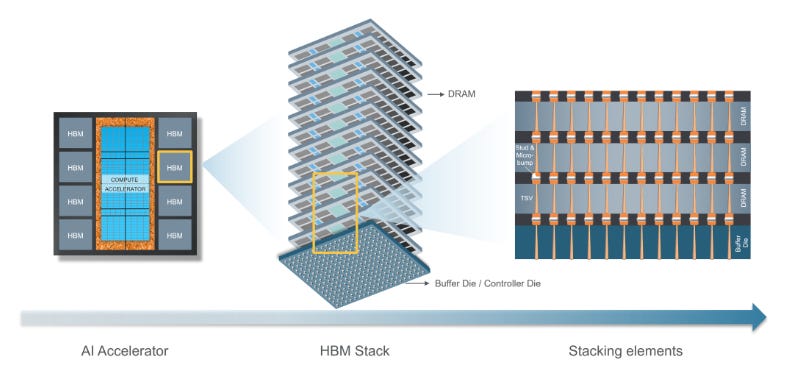
So when Samsung shifts a fifth of its factory floor toward HBM, consumer output doesn’t fall by a fifth. It falls by closer to half. AI buyers also prepay: Samsung and SK Hynix have sold out their entire 2026 HBM production to Nvidia, Google, Meta, and Microsoft, locked in before the first wafer was cut. Even if phone demand spikes tomorrow, there’s no capacity left to redirect.
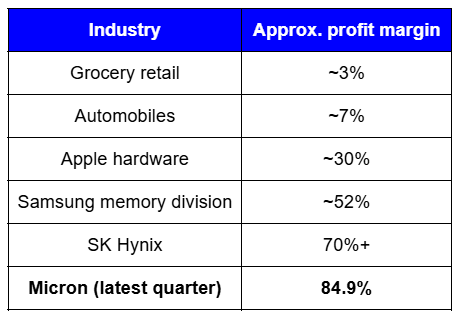
The consequence shows in one number: Micron’s gross margin went from 39% a year ago to 84.9% now, ahead of Nvidia’s. Samsung’s semiconductor division alone generated roughly 94% of the company’s quarterly profit.
Scarcity, or Something Else?
Is this genuine scarcity, or are three companies controlling nearly the entire world’s memory supply simply extracting what they can? The honest answer is both, and there’s a clever way to tell them apart.
The scarcity test: Samsung’s phone division buys memory from Samsung’s own semiconductor division. Same parent company, no internal discount. Samsung Mobile pays exactly what Apple or Xiaomi pays. If this were purely coordinated pricing, Samsung would spare its own phone business. It hasn’t. The scarcity is real enough that even the biggest winner can’t escape it.
The extraction evidence: Scarcity alone doesn’t explain everything else that’s changed:
- Long-term supply contracts – the annual agreements that let Dell and Lenovo plan ahead have effectively been killed
- Suppliers have replaced them with quarterly pricing, which allows four price increases a year instead of one
- Hyperscalers have absorbed 60–70% server-memory hikes in single renegotiations
- Being sold out eighteen months ahead and still repricing quarterly isn’t just a response to scarcity. It’s a choice about how much upside to keep
Here’s what that upside looks like next to every other industry:
The Letter That Didn’t Need to Be Honoured
In October 2025, OpenAI signed a preliminary agreement with Samsung and SK Hynix for up to 900,000 DRAM wafers a month – close to 40% of world DRAM production, for its Stargate buildout. Sam Altman flew to Seoul to close it, and that signal is widely credited with pushing both suppliers to accelerate the wafer reallocation above.
Five months later, Oracle and OpenAI quietly cancelled the Stargate expansion that letter was meant to supply, not because demand cooled, but because Nvidia’s chip generations now ship annually, and OpenAI preferred newer hardware. The letter, by multiple reports, was non-binding. Nobody had to buy a single wafer.
None of this brought prices down, because Samsung and SK Hynix had already reorganised around the signal.
A demand signal and a demand commitment are not the same thing, but once a supplier reorganises its factories around the signal, the difference stops mattering to your wallet.
Betting Nine Dollars to Earn One
The number funding all this barely fits a single earnings call. Consider:
- In Q1 2026, the US Bureau of Economic Analysis found AI-related investment drove roughly three-quarters of that quarter’s entire GDP growth, nearly matching consumer spending’s contribution despite being a fraction of the economy’s size
- Amazon, Microsoft, Google, and Meta’s combined infrastructure spend is climbing toward $725 billion for 2026 alone
Sequoia’s David Cahn first tried pricing what that spending needs to earn back. In 2024 he set the bar at $600 billion in annual revenue, “AI’s $600 billion question.” It didn’t hold: by July 2026, with spending near $1.5 trillion, Cahn had revised his own bar to roughly $3 trillion. The major labs combined generate a fraction of that.
Altman himself has said investors are over-excited about AI even though the technology is real and some will lose a lot of money.
The strain already shows inside the companies paying for it:
- Gartner: only 28% of AI projects are meeting ROI targets; one in five fail outright
- Morgan Stanley: barely one in five S&P 500 firms can cite a measurable AI benefit
- Financial Times (June 2026): Amazon, Walmart, Cisco, Uber, and Meta are all capping internal AI budgets
- Uber, having burned its annual AI budget in four months, now caps employees at $1,500/month in tokens
None of this is unprecedented. Two precedents, a century and a half apart, are worth holding together because neither tells the full story alone.
1. The telecom fibre bust (1996–2001): US telecom firms poured hundreds of billions into fibre on the promise traffic would double every few months forever. When growth came slower:
- Lucent’s stock fell from $65 to 76 cents in three years
- Nortel posted a single-quarter loss of $19.4 billion
- The shock reached India too. Sterlite Optical took a hit on the BSE purely because its US customer, JDS Uniphase, had warned on profits
Years later, YouTube and cloud computing arrived and needed exactly the overbuilt capacity nobody could sell in 2002. The technology was real. The financing collapsed anyway.
2. Railway Mania (1840s Britain). This one ran on household money, not corporate debt. British clerks and shopkeepers, often on a 10% deposit, poured savings into railway construction.
- At the 1847 peak, annual railway investment hit roughly 7% of Britain’s GDP, nearly half of national investment that year, dwarfing AI-related investment’s current 1.6% share of US GDP
- A third of authorised lines were never built
- Promised 10% dividends settled under 2%
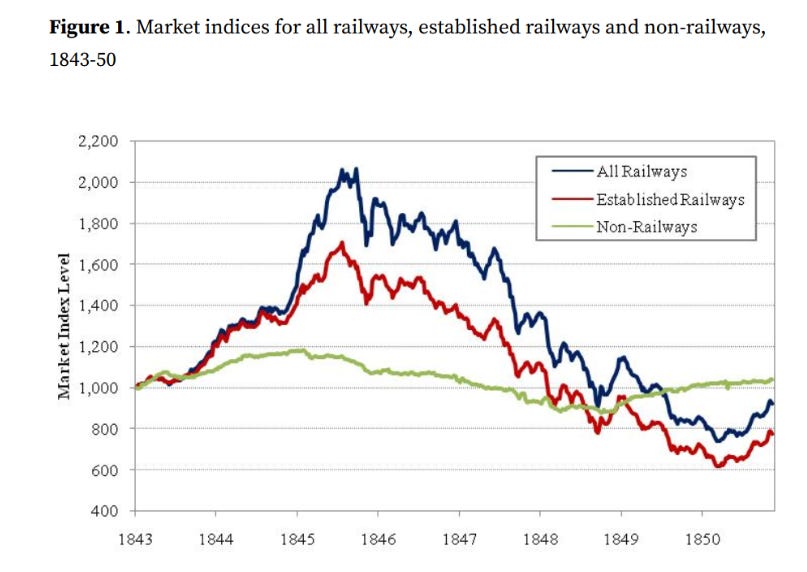
Yet the railways that were built cut freight costs 50–70% and became Britain’s industrial backbone for a century.
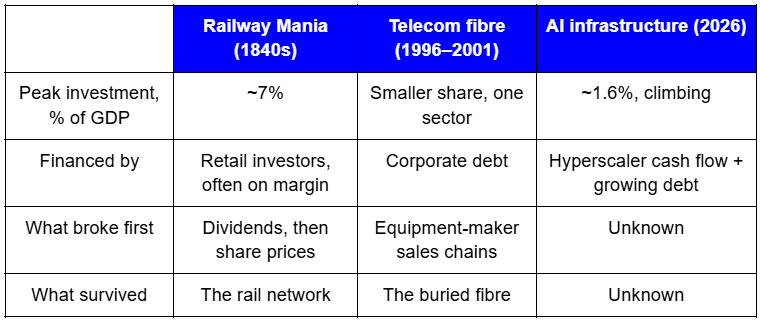
Neither case was decided by whether the technology was real. Fibre and railways both were. What decided it was whether the capital could survive the gap between spending and demand arriving. On that question, 2026 is offering evidence both ways at once.
The Bill Nobody in the Middle Can Escape
The bill is already split unevenly, and India sits in an uncomfortable spot.
- Flagship buyers: Apple and Samsung can raise prices, and loyal customers pay anyway
- Mid-range buyers: the ₹15,000–₹30,000 phones most Indians actually buy don’t have that luxury. Manufacturers can’t pass on a 25% memory-cost rise without losing customers. So watch the spec sheet, not the price: 8GB quietly becomes 6GB, same price, worse phone
Layered on top:
- Section 232 tariffs
- A rupee weakened by Hormuz-driven oil pressure
- Windows 10’s forced replacement cycle
Little surprise, then, that India’s certified pre-owned electronics market is projected to hit $10 billion this year, growing even as new shipments fall.
What Actually Ends This
Two routes lead back to cheaper memory, and neither arrives cleanly:
- New supply: China’s CXMT and YMTC are tripling capacity, but real volume only lands by late 2027, and CXMT is itself already oversold to Chinese AI labs.
- A capex bust: This one comes with a catch: a manufacturer sitting on an 85% margin has little reason to flood the market the moment demand softens. It can just as easily cut production and defend the price instead.
Shortage and premium look identical from a showroom shelf. Only one of them is guaranteed to end when the AI story does.
The Only Honest Ending
Six days after SK Hynix’s record listing, it had crashed harder than ever in its history, recovered most of the damage, and been rated a buy by every analyst but one. Nobody, not the analysts, not Samsung, not Altman himself, actually knows which of those six days told the truth.
The next time you’re in a showroom deciding whether to buy now or wait, that’s the real question under the price tag: not what the chip cost to make, but which of six wildly different days in Seoul you’d have believed, watching in real time.
The market wasn’t watching. It was voting.