
Last week, in part 1 of Water series, I spoke about multiple use cases of water simultaneously coming up – ethanol, data centers and of course drinking water. And we discussed how the Government might be thinking to prioritise them.
This week, we look at various listed (and few unlisted) companies in India which are into different segments catering to the theme of “water” as an industry.
Let’s deep dive.
_______________________
Two earnings calls happened within twenty-four hours of each other in late May.
Both from companies in the same sector. Both discussing the same quarter.
The first was VA Tech Wabag’s. A hundred-year-old water company quietly noted:
● Nearly 20% revenue growth
● A record profit
● Six straight years of positive net cash
● An order book worth more than four times its annual revenue
The chairman spent a good ten minutes on why seawater and sewage are the only two water sources immune to a bad monsoon, and how his company had spent a decade building what it calls “Manufactured Water,” as if it were a category of its own.
The second call, the next evening, was EMS Limited’s. It opened with an apology.
Revenue had fallen more than a third short of the previous year. Inventory was stuck as unbilled work. The promoter took responsibility for it, then spent the next hour explaining, politely and then less politely, to a room of increasingly skeptical retail investors, why none of it was really their fault.
Same sector. Same three-month window. Same government paying the bills.
Wildly different rooms.
If Part 1 of this series was about the crisis about the water table India’s AI, ethanol and semiconductor sprints are all quietly drawing from, this one is about who actually gets paid to fix it. And why that turns out to be a far messier, more interesting business than “buy water stocks” would suggest.
What you’re actually buying when you buy “water”
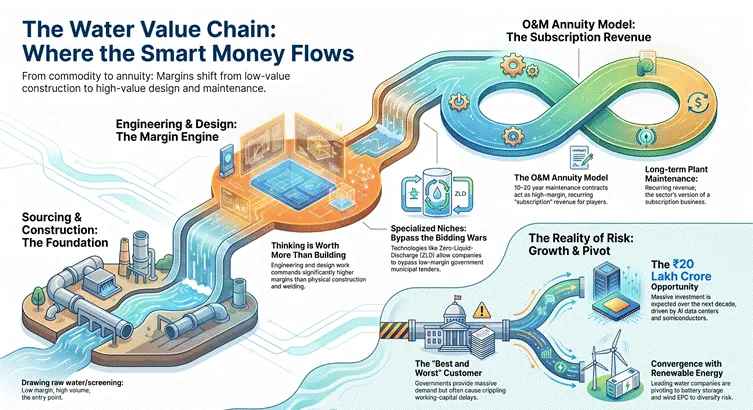
Strip away the ticker symbols and the water sector is really just three jobs, done in sequence, for whoever’s willing to pay:
- Get the water (sourcing)
- Clean the water (treatment)
- Move the water (distribution)
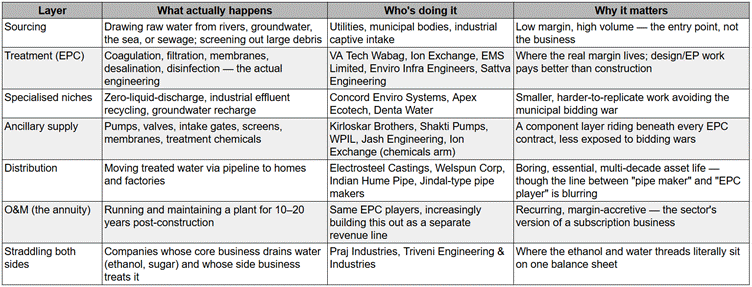
Sourcing is the least interesting part commercially. Rivers, groundwater, the sea, sewage – all just inputs waiting to be screened of debris.
Distribution is unglamorous infrastructure: ductile iron pipes chosen over steel or copper because they survive a century of pressure without corroding, made by names like Electrosteel Castings and Welspun Corp that most investors will never give a second thought.
Indian Hume Pipe, the pioneer of the category, turns 100 this year and it’s a useful reminder that the line between “distribution” and “treatment” isn’t fixed. The company has quietly stopped being just a pipe manufacturer, now bidding for and winning full water-supply EPC contracts with a decade of O&M built in, the same annuity structure the treatment players are chasing.
The real business, the one with actual engineering and actual margin, sits in the middle: treatment.
This is where an EPC (engineering, procurement, construction) company earns its fee designing coagulation and filtration systems, choosing membranes, running the processes that turn contaminated water into something a city or a factory can use.
VA Tech Wabag, Ion Exchange, EMS Limited, and Enviro Infra Engineers do most of the heavy lifting here on the listed side, alongside a longer tail of pump and chemical suppliers underneath them.
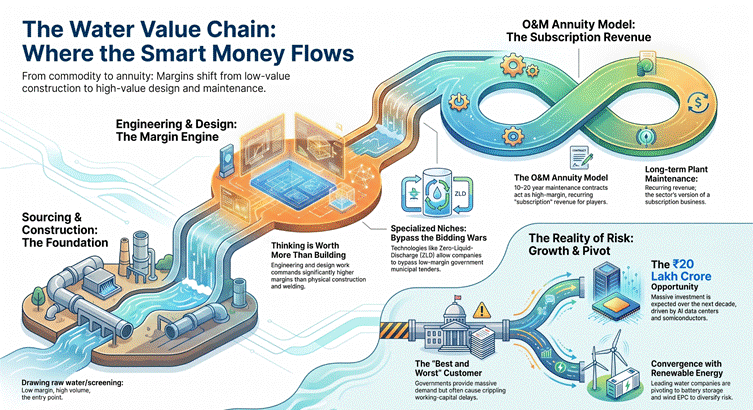
And even within that middle layer, there’s a hierarchy nobody outside the industry seems to notice: the thinking is worth more than the building.
Wabag breaks out its own margins this way – construction work, the physical pouring and welding, is the lowest-margin part of what it does. The engineering and design work sitting above it commands the best. The company that owns the blueprint earns more than the company holding the wrench, even when they’re the same company.
Then there’s a fourth job almost nobody talks about, and it’s where the smart money in this space is quietly heading: running the plant once it’s built.
Operations and maintenance (O&M) is a 10, 15, sometimes 20-year annuity contract to keep a treatment plant working, paid on outcome rather than effort. Wabag has pushed O&M to nearly 40% of its order book by value and is explicitly trying to grow it further. Unlike a two-to-three-year construction contract, an O&M contract doesn’t end when the concrete sets. It just keeps paying.
The value chain, mapped:
The moat nobody’s naming
Here’s the genuinely underappreciated part of this chain: not every company in it is trying to win the same game.
The legacy incumbents in Indian water EPC still lean heavily on municipal contracts – high-volume, fiercely competitive, thin-margin work, the kind where a dozen companies bid down to the lowest number just to keep the lights on.
It’s also the riskiest end of the pool for a smaller player. Sattva Engineering, a Chennai-based EPC company that IPO’d last year building water supply schemes and sewage treatment plants almost exclusively for Tamil Nadu’s municipal bodies, has seen its stock fall roughly a third over the past year, despite fresh work, including a ₹108 crore sewage plant order in June alone. Precisely because that single-state concentration is exactly what investors are learning to price down.
A newer cohort of smaller players has been doing something quieter and cleverer: avoiding that bidding war altogether.
● EMS Limited, in its stronger quarters, chases specialised niches like zero-liquid-discharge systems, where fewer competitors can credibly bid and margins run meaningfully higher.
● Concord Enviro Systems, India’s second-largest ZLD solutions provider by revenue and a mainboard listing since December 2024, is the cleanest illustration of both the promise and the risk of that strategy: it just won its largest-ever O&M contract, but FY26 was still rough. EBITDA margin collapsed from 14.6% to 6.6% as revenue slipped and costs rose. Specialised doesn’t mean immune.
● Apex Ecotech, a smaller Pune-based specialist that’s spent over a decade building nothing but industrial ZLD and effluent recycling systems for sectors like steel and pharmaceuticals, is a purer version of the same bet.
● Ion Exchange has gone further still, partnering with the German filtration major MANN+HUMMEL to bring advanced membrane bioreactor technology into the country, positioning itself against global giants like DuPont, Toray and Veolia rather than the domestic EPC crowd it grew up with.
That’s the real structure of this sector right now: a slow bifurcation between commodity EPC, where everyone fights over government tenders at wafer-thin margins, and specialised technology plays, where a handful of companies are trying to make themselves genuinely hard to replace.
It’s not unlike watching an IT services industry realise, twenty years too late, that staffing bodies pays worse than owning intellectual property.
The sector’s actual character flaw
If there’s one thing every one of these companies will eventually tell you, sometimes unprompted, sometimes only after an investor drags it out of them – it’s this: the government is both the best customer in this business and the worst one to depend on.
Best, because the demand is real and not going away. A report from PL Capital released at the end of June puts the water sector’s investable opportunity at roughly ₹20 lakh crore over the coming decade, with AI data centres and semiconductor fabs named as fresh demand layered on the older municipal and irrigation story.
Worst, because getting paid runs through a government payment machine that moves on its own schedule, not the contractor’s.
This isn’t abstract. India’s flagship rural water program, the Jal Jeevan Mission, was just restructured this spring into “JJM 2.0” – a ₹8.69 lakh crore outlay. But the fine print is the story: states now have to sign reform-linked agreements and clear technical validation checkpoints before money moves, a deliberate shift from simply handing out construction funds.
Sensible reform on paper. In practice, a transition period where government payment runs slower than usual, right when contractors already have people and machinery deployed on-site.
Same quarter, seven very different stories:
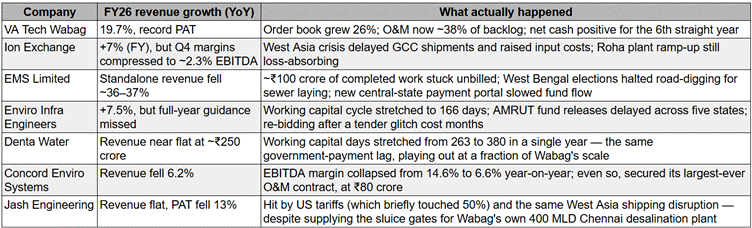
A few things worth pulling out of that table:
● EMS had ₹100 crore of physically completed work sitting as unrecognised inventory, on top of election-related work stoppages in West Bengal.
● Enviro Infra openly told investors it was pacing execution to match government cash landing in the bank rather than the schedule on paper, self-rationing growth to avoid a working-capital hole it couldn’t climb out of.
● Layer on the months-long conflict in West Asia, which disrupted shipping through the Strait of Hormuz before a ceasefire was signed in mid-June, and both Ion Exchange and Enviro Infra saw input costs and exports hit in the same quarter.
A reminder that a sector selling into the Gulf’s desalination boom is also exposed to the Gulf’s volatility, in both directions, at once.
None of this means the underlying businesses are broken. It means the sector’s real risk was never about water, it’s about cash flow timing in a business where the customer is a government, the receivables sit for months, and a single missed fund release or one regional conflict can turn a good quarter into an ugly one, regardless of how sound the engineering is.
Wabag’s insulation from most of this comes from a deliberate choice: it only takes on projects funded by multilateral agencies or sovereign guarantees, and won’t touch anything funded directly by state governments or municipalities. That’s a lesson the smaller players are learning the hard way, in real time, this year.
The boundary that’s quietly dissolving
Here’s the piece of this story I think almost nobody outside these earnings calls is watching closely.
In Part 1, the interesting move was energy conglomerates walking into water. Reliance and Adani, using their captive power and refining infrastructure to build desalination plants that could cool their own data centres.
What’s happening now is the same trade running in reverse.
Enviro Infra Engineers has spent the last year diversifying out of pure-play water into renewable energy:
● Acquired Suyog Urja, a wind EPC business
● Won a ₹1,070 crore battery storage contract from NTPC across four states
● Built a 250-person renewable energy team from scratch
The logic is almost identical to Reliance’s: water and clean energy are becoming the same infrastructure problem, viewed from opposite ends.
It’s not a one-off. SPML Infra, a four-decade-old water and power EPC player, reclassifying its own promoters as non-executive directors, cleaning up legacy debt through arbitration awards, used the same moment to sign an exclusive 10-year partnership with Energy Vault for battery storage, and is now building a manufacturing facility targeting 5 GWh of capacity by FY28. Two separate water EPC companies, in the same year, independently deciding the smartest place to point their next rupee of capex is grid-scale batteries, not more sewage plants.
Water companies are becoming energy companies. Energy companies are becoming water companies. The two sectors we said were quietly competing for the same finite table are, for a certain kind of large player, starting to merge into one business.
Two listed companies embody this without ever having pivoted at all. Praj Industries is the dominant technology supplier behind India’s ethanol blending program – roughly half the domestic market, and the literal engine behind India’s ethanol sprint. What almost nobody connects: ethanol manufacturing is itself water-intensive and effluent-heavy, so Praj has run a parallel high-purity water and industrial wastewater treatment business, Praj HiPurity Systems, for years. The same company is selling the technology for the crisis and a piece of its mitigation, quietly, under one roof.
There’s a sharper twist in the timing. Praj’s results for the quarter ending March 2026, reported in late May, showed profit down roughly 71% year-on-year, and management said so plainly on the call: greenfield ethanol plant orders have slowed now that India has already hit its blending target, with the next leg of growth dependent on the government mandating an even higher blend. The engine that helped drain the water table is, for the moment, running out of new plants to build. Its water business is the steadier, quieter half of the same balance sheet.
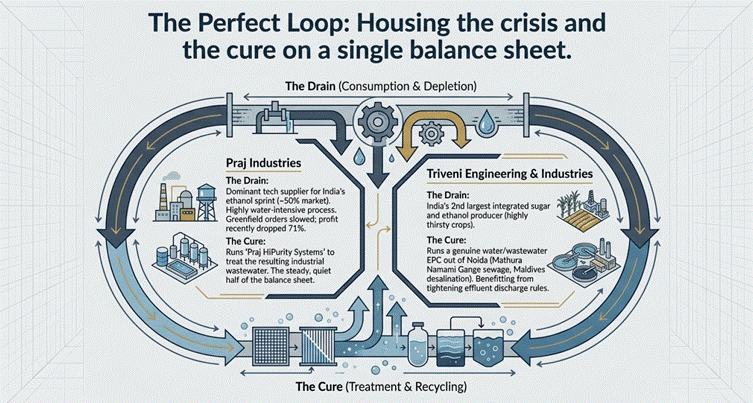
Triveni Engineering & Industries takes this even further. It’s India’s second-largest integrated sugar and ethanol producer – the sugarcane-to-ethanol pipeline that’s one of the thirstiest crops in the country, and it separately runs a genuine water and wastewater treatment engineering business out of Noida, including the Mathura sewage project under Namami Gange and a desalination plant built in the Maldives. On its own most recent earnings call, management pointed to tightening effluent discharge rules as a fresh tailwind for that water business, and said they’re hopeful of more orders there soon. One arm of the same company draws down the water table for sugarcane and ethanol; another arm gets paid to help clean up what’s left. It’s not a contradiction Triveni particularly hides. It’s simply never been asked about in these terms.
There’s a second, quieter version of this story we haven’t touched yet – companies that make their living off water without ever calling themselves a water company. Pump and valve manufacturers who count desalination as one end-market among several. Diversified industrial groups where water infrastructure sits next to waste-to-energy and rail wagons on the same balance sheet.
We’ve already started poking around that list, and it’s a strange one. Half of it doesn’t show up in a “water stocks” screener no matter how you build it. More on that once we’ve actually earned the right to write it.
Where that leaves you
None of this is a stock tip, and it shouldn’t be read as one. The sector spans companies with genuinely different risk profiles… from a hundred-year-old cash-generative technology leader like Wabag, to smaller, more fragile players like EMS still working through a rough year of missed guidance and stretched working capital.
What it should leave you with is a map, not a shopping list: sourcing, treatment, distribution, and now O&M and energy convergence sitting on top, each layer with its own economics, its own risk, and its own reason to exist independent of how loudly the AI-water-crisis headlines keep shouting.
Nikhil, from Part 1, still doesn’t know how much water that data centre near his society uses. But somewhere in the value chain we’ve just walked through, there’s a company that’s already been paid (or is still waiting to be) to make sure whatever water it does use gets there, gets cleaned, and gets recycled back out.
That’s the business hiding underneath the crisis. It was never as simple as “water good, buy water.”
If you are looking for more such thematic coverage of trending (and many times, to-be-soon trending) topics, considering subscribing by hitting the below button.
Disclaimer: I am not a registered SEBI Research Analyst and anything in the above article should not be construed as a recommendation. This should be read solely for education purposes.