

Are you ready?

Mark Zuckerberg just made the most expensive hire in consumer tech history. He paid $900 million for it. The deal came attached with a 20% stake in an Indian fintech, which Meta politely accepted but clearly didn’t need — no board seat, no data access, no operational control whatsoever.
That is not an investment in a business. That is an acqui-hire wearing a minority stake as a disguise.
The man Zuckerberg needed was Kunal Shah, founder of CRED, now running WhatsApp for three billion people. On accepting the job, Shah posted that the delta between WhatsApp today and its full potential is “massive.” He reached, instinctively, for the one word his entire worldview is built around. If you have ever tried getting your family to switch to, say, Telegram, you already understand his framework.
The paradox at the centre of India’s growth story
India is not simply a large market. It is the world’s most extreme case of concentrated purchasing power sitting on top of a mass-market distribution layer.
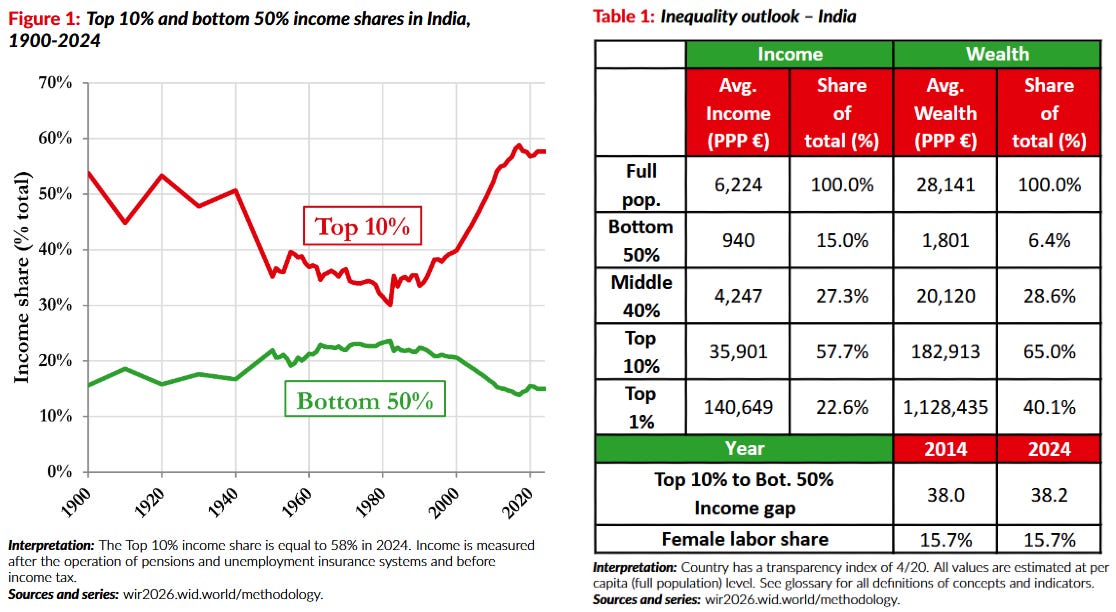
India’s top 10% of earners capture 58% of national income. The top 1% holds about 40% of national wealth. The bottom 50% share 15% between them. These are not development statistics — they are the operating system every consumer business has to run on.
Kunal Shah has a framework for why this bifurcation runs so deep. He argues India is structurally a status-driven rather than a wealth-driven society. Wealth is positive-sum: when one person creates it, others nearby often gain. Status is zero-sum — if you rise, someone falls. His evidence: government jobs that pay less than private-sector roles but signal security; weddings calibrated to the guest list rather than the couple; living room furniture carrying 3x the margin of bedroom furniture, because the living room is the part guests see. A country optimising relentlessly for how things look rather than what they return.
This has a direct bearing on why WhatsApp Pay failed — and why the fix is harder than it looks.
The embarrassing number
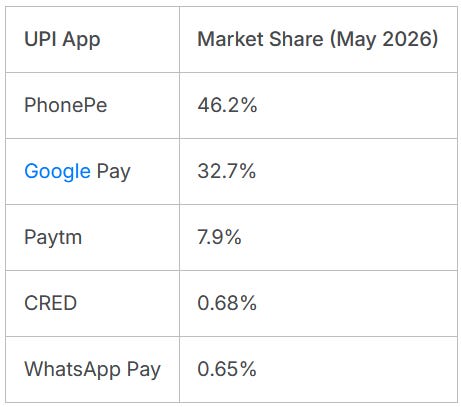
As of May 2026, WhatsApp Pay held 0.65% of India’s UPI market. Not 6.5%. Point six five.
India processed 23.2 billion UPI transactions that month. WhatsApp, with 500 million monthly active users — the single largest WhatsApp market on earth — captures a slice so thin it barely registers on charts. PhonePe sits at 46%. Google Pay at 33%. Even CRED, serving a far narrower premium cohort, ranked above it.
The standard explanation is timing: PhonePe and Google Pay entered in 2016–17 while WhatsApp Pay was stuck behind a regulatory wall until 2020, by which point the habits were already set. Accurate, but incomplete.
Shah’s Delta 4 theory holds that products only permanently displace existing behaviour when they are dramatically more efficient — a four-point gap on a ten-point scale. Below that, people drift back. Above it, the behaviour becomes irreversible.
WhatsApp Pay never achieved Delta 4 over PhonePe. The functionality was comparable. What was missing was the status signal. PhonePe’s cashback campaigns and scratch cards made people feel like smart users of a purpose-built financial tool — a Unique Brag-worthy Proposition in Shah’s taxonomy. WhatsApp Pay had no such hook. It was a feature inside a messaging app that Indians mainly used to send screenshots of their PhonePe payments.
The irony is almost too complete to be accidental.
Why Kunal Shah, specifically
A fair reading of Shah’s ideas requires some intellectual honesty here. Delta 4 is a compelling framework, but it is most useful as a lens for reading the past. It explains IRCTC, Swiggy, and WhatsApp cleanly — after the market has already voted. As a forward predictor, it has a softer edge, because you can only measure the delta after the market has already decided.
What makes Shah valuable to Meta is not the framework. It is the muscle memory of having built trust from scratch, twice over, in a market that does not hand it out easily.
Shah has described India as a low-trust society — not as a judgment, but as a structural diagnosis. In a low-trust market, the counterintuitive prize is immense: trust does not spread evenly, it pools. Tata sells salt, software, cars, and air travel because its trust architecture does all the acquisition work for free.
CRED was Shah’s bet that trust could be productised. The 750+ credit score entry gate was not a filter — it was the product. Members trusted the platform precisely because the platform had first trusted them. Banks competed to be listed. The trust dynamics ran in reverse of every other fintech.
Now he runs WhatsApp: the largest trust and identity layer ever assembled, on three billion phones. The man obsessed with how trust pools in low-trust societies has just been handed the largest pool on earth. Meta did not plan that connection — it just paid $900 million to walk through the door.
The super app graveyard
India has a long, unmarked cemetery of failed super app attempts. Paytm stitched together payments, movies, travel, and food delivery and produced a cluttered experience that served none well. Tata Neu arrived with the country’s most trusted brand behind it and reported a $165 million net loss in its first year. Jio has coverage. Adani One has ambitions. Nobody changed their home screen.
The consensus diagnosis is fragmentation. But that misses the structural point. WeChat succeeded because it started as a messaging app and layered financial services onto a pre-existing daily habit. The backbone of a super app must be a high-frequency use case. Every prior Indian attempt started from payments or commerce — low-frequency categories — and tried to manufacture sessions upward. WhatsApp already owns the sessions. It has always lacked the money layer.
What happens next — and the honest caveat
NPCI’s 30% per-app UPI cap, if enforced by December 2026, will structurally force PhonePe and Google Pay — currently at 46% and 33% — to shed volume. That overflow needs somewhere to go. WhatsApp, already on 500 million Indian phones, is the only app that can absorb that volume without spending a rupee on acquisition.
Shah will not try to out-PhonePe PhonePe. The smarter play is to go upstream: build the premium commerce layer, use CRED’s member DNA to position WhatsApp as the financial interface for India’s creditworthy class — insurance premiums, investment SIPs, high-value rent. Transactions where trust is the entire product. Layer on Meta’s Business AI agents, already live inside WhatsApp in India, enabling commerce in native languages without third-party tools.
The race sharpens into two camps: Google (GPay + Gemini + Android) versus Meta (WhatsApp + AI + CRED’s premium cohort). Jio watches from the sidelines.
But here is the honest caveat Shah’s own framework supplies: CRED ran Rs 1,461 crore in losses on Rs 2,803 crore in revenue last year. The trust architecture is world-class. Whether the thesis holds as a durable business remains genuinely open. Diagnosis and construction are different muscles, and Shah has until now operated on a canvas he designed himself. WhatsApp is a product he did not build, running on forces he spent a decade describing from the outside.
Shah once said: in a long enough time frame, all Gods get replaced with new ones. He was not talking about WhatsApp. But he could have been. The question for the next two years is whether he can build the money layer before someone else builds the trust layer — or before his own framework, applied to WhatsApp, produces its most ironic outcome yet.
Capital Quill covers Indian macroeconomics, capital markets, and financial narratives for retail investors. If this landed, forward it to someone who still thinks WhatsApp is just for family forwards.