
Reliance built the highway. Everyone else built the cities along it.
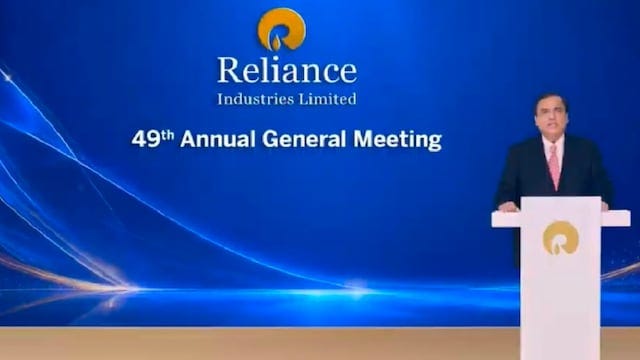
At its 49th AGM last week, Mukesh Ambani did what he does every few years: he stood up and redrew the map of what Reliance is supposed to be.
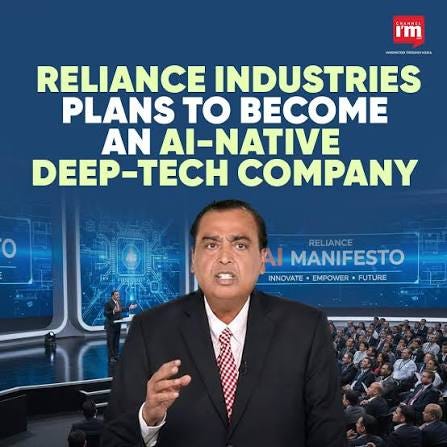
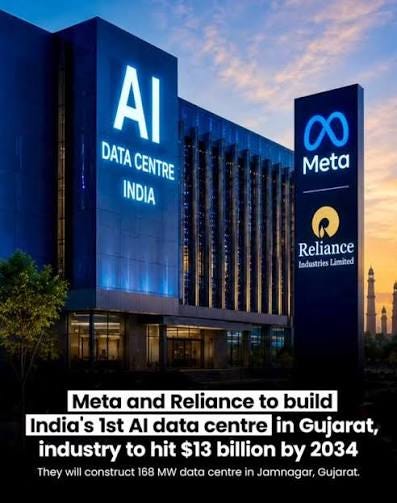
The headline announcements were a Jamnagar AI data centre running entirely on renewable power, an initial deployment of Nvidia’s GB300 GPUs with compute equivalent to over 75,000 H100s (scaling toward 200,000), a Jio-native AI agent you can summon mid-call just by saying “Hey Jio,” and deepened partnerships with Google (Gemini, free for Jio users) and Meta (sovereign hosting of Llama for Indian enterprises). Layer on the Jio IPO’s DRHP filing, and you have a company once again insisting it is not what you think it is.
It’s tempting to read all this as Reliance entering the AI race. I’d argue it’s something narrower and, frankly, more interesting: Reliance is not trying to build AI. It’s trying to build the on-ramp to AI for 1.4 billion people. That distinction is the whole story.
The strategy has never changed, only the product
Look at the pattern since 2016. Reliance rarely invents the underlying technology. It did not build 4G, it bought spectrum and bet enormous capital on distributing it cheaper than anyone thought sane.
It is not building large language models from scratch; it’s licensing Gemini and Llama and wrapping them in Jio’s distribution.
Contrast this with Tata, which is pouring capital into semiconductor fabrication and OSAT plants — actual manufacturing, actual deep-tech sovereignty, slow and capital-intensive. Reliance has shown almost no comparable appetite for chips. That’s not an oversight. It’s a different theory of where value gets captured.
Reliance’s bet is that the scarce resource in India was never the cutting-edge technology — that exists somewhere in the world already. The scarce resource is mass, affordable access to it.
So the playbook is consistent: borrow the frontier technology, negotiate hard on cost, and then scale distribution so aggressively that the price collapses and adoption becomes inevitable. Once that happens, Reliance doesn’t need to own the next layer up — fintech, e-commerce, edtech, AI agents — because thousands of other companies and individuals will build it for them, on top of the rails Reliance laid down.
We’ve already seen this movie
Jio’s 2016 launch is the cleanest case study. Cheap data wasn’t an end in itself — it was the precondition for an explosion that Reliance didn’t fully orchestrate but undeniably enabled.
UPI’s volumes, the fintech boom, OTT consumption, wealth-tech apps, the entire vernacular-internet economy — none of this required Reliance’s permission or product, but almost none of it would have scaled the way it did without dirt-cheap, ubiquitous mobile data. Reliance built the highway. Everyone else built the cities along it.
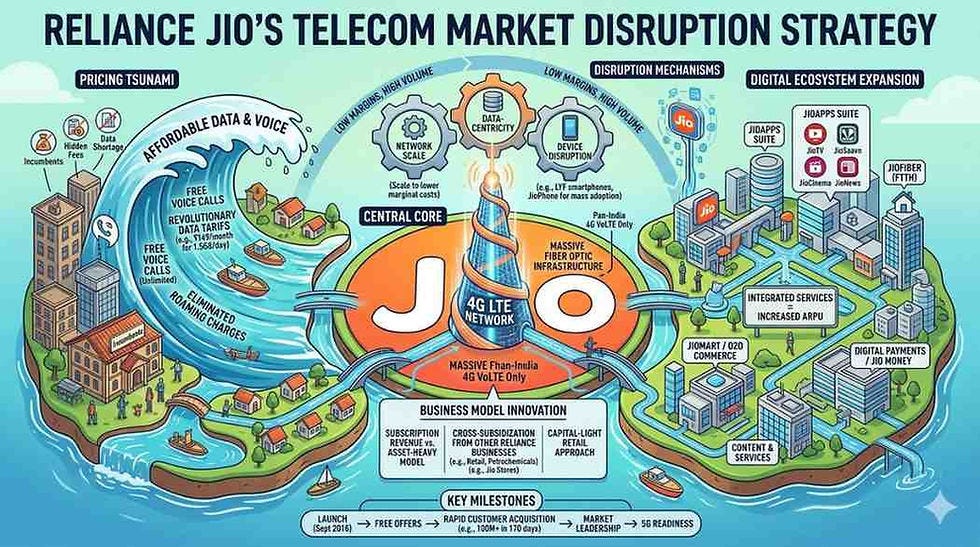
That’s the lens to apply to the AI announcements. A sovereign, India-priced AI compute layer plus a free Gemini tier plus an embedded voice agent isn’t really a product pitch — it’s infrastructure. The bet is that affordable AI access becomes the substrate, and an ecosystem of startups, MSMEs, and individual builders does the inventing on top of it, the way they did with payments and content after 2016.
But “enablement” has a mixed track record
Here’s where the analysis has to get less generous, because the model isn’t infallible.
JioBlackRock launched its early debt funds with zero expense ratio and zero distributor commission — pure Jio-style land grab through free distribution. But asset management economics don’t work indefinitely at zero; regular plans with distributor fees have since followed, the same eventual monetisation that every “free first” Reliance product has had to confront. The open question is whether the initial land grab converts loyal users before the free layer disappears, or whether it just trains price-sensitive Indian consumers to leave the moment a fee appears.
JioMart is the sharper warning. Despite the distribution muscle of Reliance Retail and the install base of Jio, JioMart has not meaningfully dented Amazon, Flipkart, Blinkit, or Zepto’s hold on Indian e-commerce and quick commerce. Mass distribution at low cost worked spectacularly for a commodity like data, where the product is invisible and the only variable that matters is price. It has worked far less well in retail, where consumer habit, assortment, delivery experience, and brand trust matter more than just being cheap and everywhere.
Enablement, in other words, isn’t a universal cheat code — it works when the product is infrastructural, and struggles when the product needs to be loved.
What I actually keep coming back to
None of this is why I hold Reliance stock, though. What keeps me invested isn’t any single bet — it’s the refusal to sit still. Most retail investors still mentally file Reliance under “petrochemicals and refining,” and they’re not wrong about where the revenue comes from even today.
But that’s a backward-looking description of a company that has, in a decade and a half, pushed hard into telecom, retail, green energy, financial services, and now sovereign AI infrastructure.
Some of these bets have paid off enormously (Jio), some are still finding their footing (JioBlackRock), and some have underdelivered (JioMart). That’s a normal batting average for a conglomerate making this many large, simultaneous wagers.
What’s unusual is the discipline to keep making them — to treat the existing cash-cow business not as a destination but as the war chest for whatever the world is about to need next. Leadership that keeps itself on its toes, in an economy moving this fast, is itself a kind of moat.
Whether or not Reliance ever manufactures a single chip, I suspect history will record it the way it recorded the telecom bet: as the company that didn’t always build the future, but reliably built the road everyone else used to get there.
Missing manufacturing — deliberately or by drift — may turn out to matter far less than owning the on-ramp.
Disclaimer: I am not a registered SEBI Research Analyst and anything in the above article should not be construed as a recommendation. This should be read solely for education purposes.