
Geopolitics is a ruthless game of chess, and the board is currently being rearranged at breakneck speed.
In January 2026, the US moved its knight to Venezuela, targeting its leadership. In February, it moved its queen to Iran, positioning an armada near the Strait of Hormuz to intercept and contain.
Now, Washington has moved its bishop. The target is the most critical maritime corridor on the planet: the Strait of Malacca.
Recently, US Secretary of Defence Pete Hegseth hosted the Indonesian Defence Minister at the Pentagon, resulting in a quiet but devastatingly effective defence arrangement. The US military was granted expanded operational access to Indonesian airspace. Simultaneously, Indonesia has floated the idea of imposing transit tariffs on ships passing through its waters.
On paper, this looks like standard bilateral cooperation. In reality, it is a geopolitical stranglehold on East Asia’s supply chain. And sitting right at the mouth of this chokepoint is India, holding a silent, asymmetric weapon that could dictate the future of global trade.
I. The “Malacca Dilemma”: China’s Ultimate Achilles Heel
To understand the panic in Beijing, you have to look at the map.
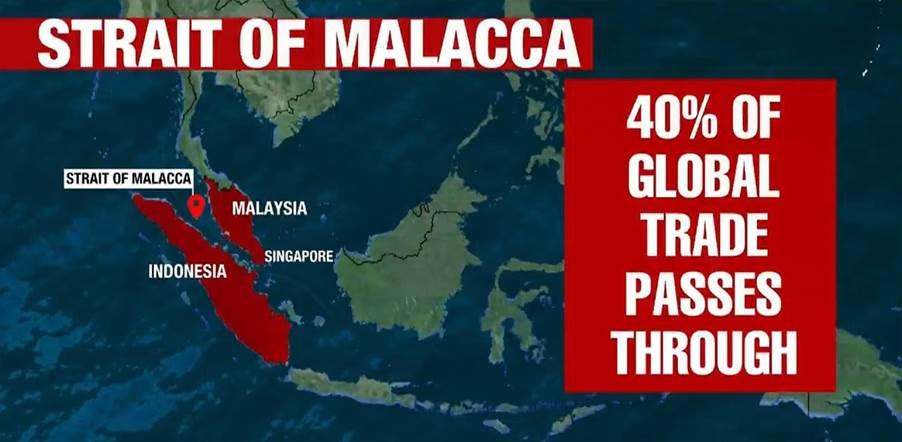
The Strait of Malacca is a 900-kilometer-long stretch of water connecting the Indian Ocean to the South China Sea. At its narrowest point, the Phillips Channel, it is just 2.8 kilometers wide—barely the width of two football fields.
Yet, this tiny funnel carries the weight of the global economy:
- The Volume: Over 60,000 to 90,000 merchant vessels pass through here annually.
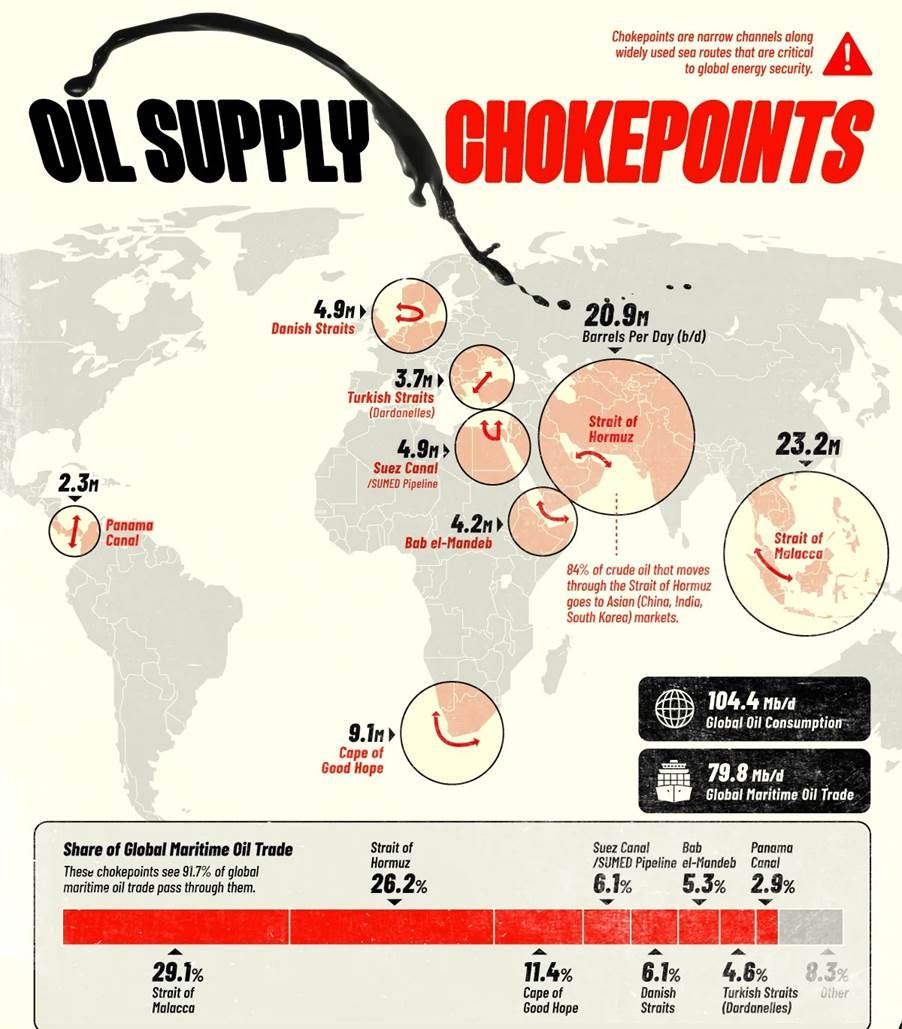
- The Cargo: Unlike the Strait of Hormuz, which is primarily an energy corridor, Malacca carries everything. It transports nearly 30% of the world’s seaborne oil (over 23 million barrels a day), but it also carries semiconductors, rare earth minerals, electronics, and food. It accounts for roughly $3.5 trillion in annual trade.
For China, this strait is a matter of life and death. Approximately 80% of China’s oil imports transit through Malacca. In 2003, former Chinese President Hu Jintao coined the term the “Malacca Dilemma” to describe this exact vulnerability.
If Hormuz is blocked, oil gets expensive. If Malacca is blocked, the factory of the world shuts down. There are no strategic reserves for semiconductors and intermediate factory components.
The US-Indonesia airspace deal means American P-8 Poseidon surveillance aircraft can now loiter over this chokepoint, tracking every Chinese submarine and tanker. Add in Indonesia’s potential transit tariffs, and the cost of keeping China’s economy running just spiked.
II. India’s Silent Weapon: The Andaman & Nicobar Islands
While the US negotiates access, India doesn’t have to. We own the front yard.
The Andaman and Nicobar (A&N) Islands are a chain of 572 islands stretching over 750 kilometers. While they account for a mere 0.2% of India’s landmass, they grant India an astounding 30% of its Exclusive Economic Zone (EEZ).
More importantly, the southernmost tip, Great Nicobar, is barely 200 kilometers from the entrance of the Malacca Strait. Any ship coming from the Middle East or Europe to East Asia must pass through the Six Degree Channel—right through India’s maritime backyard.
This geography enables a concept military strategists quietly refer to as “Spreadsheet Warfare.”
III. Second-Level Thinking: “Spreadsheet Warfare”
A common misconception is that blockading the Strait means the Indian Navy actively firing missiles at Chinese merchant ships. That would be an act of war, which nobody wants.
The reality is much more elegant, and much more ruthless. You don’t need admirals to win this war; you need actuaries.
If tensions flare—as they did during the 2020 Galwan clash—India simply needs to increase its naval patrols. Park a few P-8I Poseidon aircraft (the world’s deadliest submarine hunters) at the A&N bases. Move a couple of Scorpène-class submarines to the mouth of the channel.
We don’t fire a single shot.
But in London, the maritime insurance syndicates watch those satellite feeds. Instantly, War Risk Premiums for Chinese shipping companies skyrocket. Freight costs double overnight. Supply chains begin to bleed cash. By merely posturing, India can inflict billions of dollars in economic damage, weaponizing the global insurance market against Beijing without crossing the threshold of kinetic war.
As part of the broader strategy, India has effectively countered China’s “String of Pearls” (ports in Gwadar, Hambantota) with its own “Necklace of Diamonds.” Through strategic access to Changi Naval Base in Singapore, Sabang Port in Indonesia, and Chabahar in Iran, India has surrounded the Malacca Strait from all sides.
IV. The Master Plan: The Great Nicobar Project
For decades, India treated the A&N islands as a neglected outpost. That “sea blindness” is finally curing.
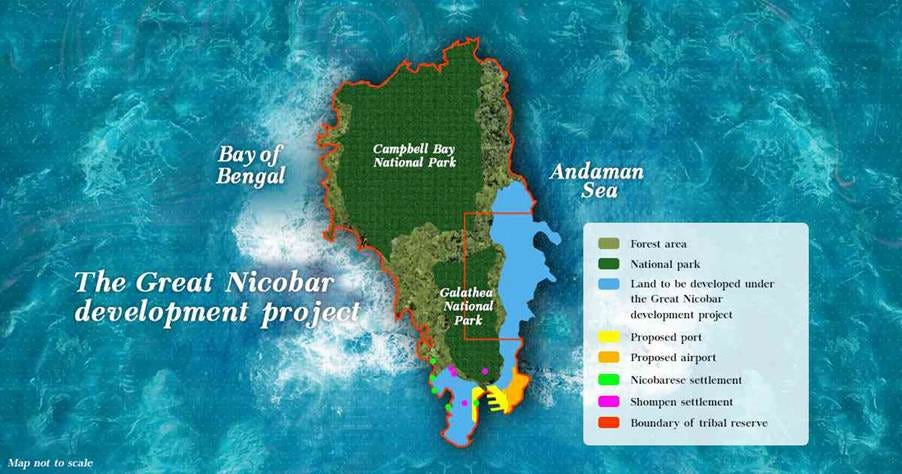
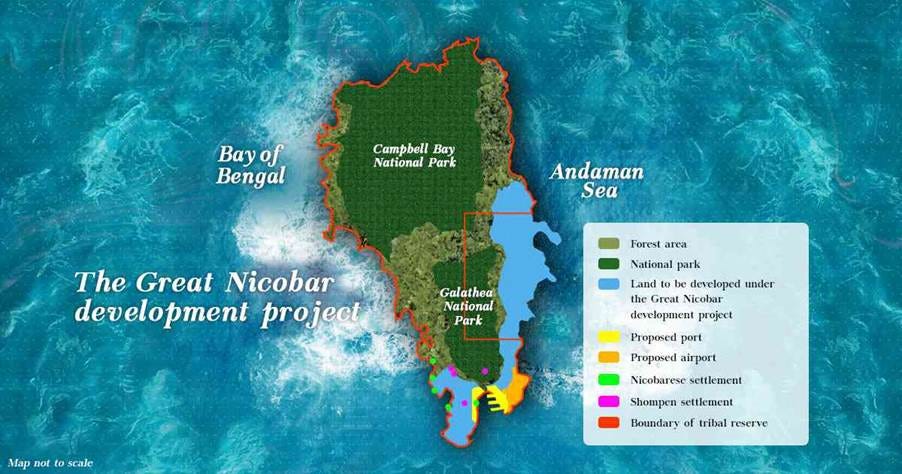
New Delhi is currently executing a massive ₹72,000 crore ($9.6 billion) infrastructure upgrade on Great Nicobar.
- The Transshipment Hub: India is building a mega International Container Transshipment Terminal (ICTT). Instead of Indian cargo going to Colombo or Singapore to be loaded onto larger mother ships, it will happen on Indian soil.
- Military Upgrades: The project includes extended airstrips capable of handling heavy fighter jets and larger jetties to dock frontline warships.
India is transforming a tropical paradise into an unsinkable aircraft carrier.
V. The Reality Check: The 19% Problem
But mature analysis requires looking at the balance sheet, not just the blueprint. And the balance sheet presents a harsh reality.
Despite controlling the most strategic real estate in the Indian Ocean, the Indian Navy receives only about 19% of the nation’s total defense budget. Because India faces active, hostile land borders with Pakistan and China, the Army consumes the lion’s share of resources.
This historic land-focus has allowed a dangerous submarine gap to open up.
While India has the geographic high ground, China possesses a massive numerical and technological advantage underwater. The People’s Liberation Army Navy (PLAN) is heavily investing in Air-Independent Propulsion (AIP) submarines and autonomous underwater drones. Furthermore, China has established a sophisticated surveillance outpost on Myanmar’s Coco Islands, sitting just north of the Andamans, keeping a constant digital eye on Indian naval movements.
The Bottom Line
The Strait of Malacca is the geopolitical fault line of the 21st century. The US and Indonesia are tightening the noose, but India holds the lock.
Our geographic advantage is absolute, but potential does not equal power. To convert this “plus point” into a credible deterrent, New Delhi must bridge the budgetary and technological gap. The real estate has been secured; now, we have to fund the fortress.